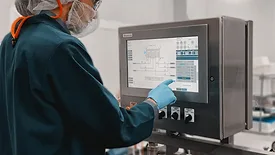
Food giants are closing legacy plants and building greenfield facilities to achieve higher volumes, greater flexibility and increased margins. So how are plant managers and corporate leadership executing, managing and delivering data to help operators find accurate KPIs and OEE metrics?
State legislative bans are targeting ingredients, dyes and cultivated products in 2025. Therefore, the market is forcing OEMs and alternative protein suppliers to get creative in manufacturing, lowering ingredient costs, and even going to market.
Executives and boards are slow to adopt new OT cybersecurity tools, and the issue is complex for non-security plant professionals. To solve this issue, security leaders need to explain the risks and impacts for increased investment.
Recent regulatory moves appear to shift the burden of food safety to manufacturers, but they’re already taking steps to ensure quality food production – including designing facilities with safety in mind.
Five years ago, sustainability meant reducing packaging material. Now, the clean label trend has taken on the mantle of sustainability, and its definition includes natural ingredients, decarbonization and recycling under the banner of clean labeling.
The definition of clean label is evolving to include not only natural ingredients but also decarbonization, reductions in virgin plastic packaging, cleaner processing, energy efficiency and more.
Traditional operator safety approaches are still in place at food plants, but dynamic digital tools and continuous training are solving problems for plant managers.
The race to standardize plant data is happening fast. As food manufacturers standardize data, digital tools accelerate and provide a closer look at overall equipment effectiveness (OEE) and maintenance metrics.
Data collection has become a major part of food manufacturing, but without data standardization, measuring overall equipment effectiveness (OEE) poses a challenge.
Food manufacturers are increasingly turning to cobots and robots to alleviate labor shortages, increase efficiency and manage tight operational footprints.
Food and beverage manufacturers are discovering that machine learning is a vital ingredient in moving to predictive maintenance strategies. Larger food companies have the jump on digital transformations, but smaller companies are starting small and increasing spending to start the journey.
FOOD ENGINEERING discusses machine learning, neural networks, Industry 4.0, data governance and other AI concepts in food manufacturing with Markus Guerster, founder and CEO of MontBlancAI.