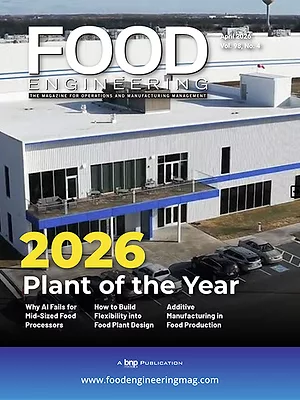
With comprehensive automation and cross-departmental collaboration, CJ Schwan’s frozen pizza manufacturing facility and distribution center in Salina, Kansas is the 2026 Plant of the Year.
Blending advanced automation with purposeful design, this year’s Plant of the Year reflects how food manufacturers are engineering smarter, more efficient operations to meet evolving industry demands.
Food producers are now modeling traditional maintenance data, such as vibration and frequency, and executing machine learning in the cloud with digital twin simulations. Anomalies are being modeled while also providing advanced analytics, reducing downtime and repurposing staff.
At the 2025 Automation Fair, Rockwell Automation CEO Blake Moret noted that manufacturers are enhancing efficiency with automation and AI. Food manufacturers use digital twin and cloud platforms for predictive maintenance, reducing workloads and improving visibility. This article covers strategies for effective implementation.
3D printing, while serving roles in package design, tools and spare parts, is finding applications for creating unique foods that aren’t practical for conventional methods.
Additive manufacturing can describe two technologies in food production — the more commonly known is 3D printing, which has been borrowed from 3D tool and parts making, but robotic work cells can also fit the definition of additive manufacturing.
Rising energy costs and global pressures are pushing food manufacturers to prioritize efficiency. ABB research shows energy makes up about a quarter of operating costs, driving investments—but real gains require a holistic, system-wide approach.
In an environment defined by rapid changes in consumer behavior, long-term success depends not on guessing the future correctly, but on ensuring the facility can adapt when the future shifts.
It is critical for manufacturers such as food processors to recognize that while AI has the potential to become the "turbocharger" of operations, that transformation rarely happens by simply bolting on use cases.
BHA is used to prevent spoilage of fats and oils and can be found in various food products including frozen meals, breakfast cereals, cookies, candy, ice cream and meat products.