Additive Manufacturing: Roles for 3D Printing and Robotics in Food Production
3D printing, while serving roles in package design, tools and spare parts, is finding applications for creating unique foods that aren’t practical for conventional methods.
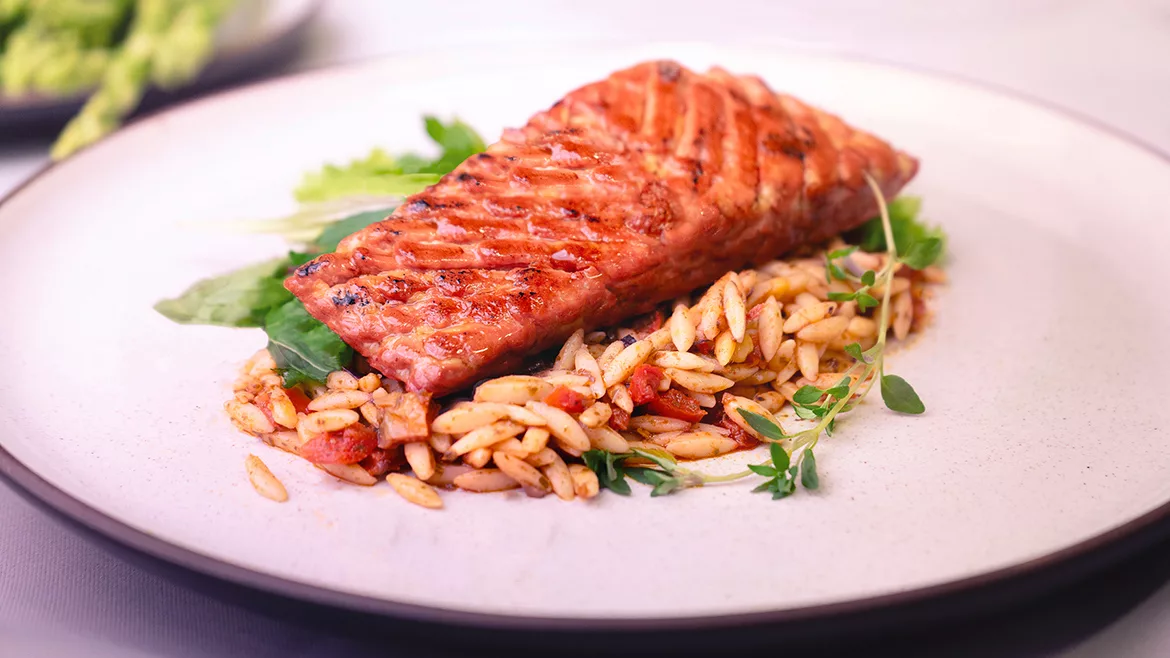
Austria-based Revo Foods’ salmon fillet is built by 3D printing techniques and features a layering of fat to resemble an actual salmon fish filet but is really derived from alternative proteins.
Additive manufacturing (AM) of food products conjures up the idea of 3D printing — as in making machine parts from 3D files such as AutoCAD.
While there are some foods being constructed in this fashion, they are typically high-end since each food is built literally from the bottom to the top, a relatively low throughput process. Some chocolates, confectionery, pastries and alternative protein seafoods and beef products are being made using this process. 3D print technology has also been used to create intricate molds and designs for chocolate products, packaging and bottle molds.
By expanding the AM definition, however, robotic work cells can also perform AM, though not necessarily in the layered fashion as with a 3D printer.
In additive manufacturing, ingredients remain discrete and identifiable, and the final product is constructed, not mixed, cut or trimmed. The recipe is defined digitally and executed stepwise. By this definition, you could argue that besides 3D printing, a robotic work cell where several pick-and-place robots assemble products like salad bowls, meals, pizza and sandwiches might also be considered an additive manufacturing technique.
3D Printing
Revo Foods is considered one of the pioneers of 3D printed foods and is known for its salmon fillet made with alternative proteins. "Since the creation of Revo Foods in 2021, a lot of research and development has been done to come up with a reliable technology to bring 3D-printed food products on the market," says Timothé Renaudin, head of engineering, Revo Foods. "[We started] from a desktop, single-printing-head 3D printer capable of producing 80 products a day, to our current industrial machinery, using eight printing heads capable of producing 2,000 to 2,500 products a day."
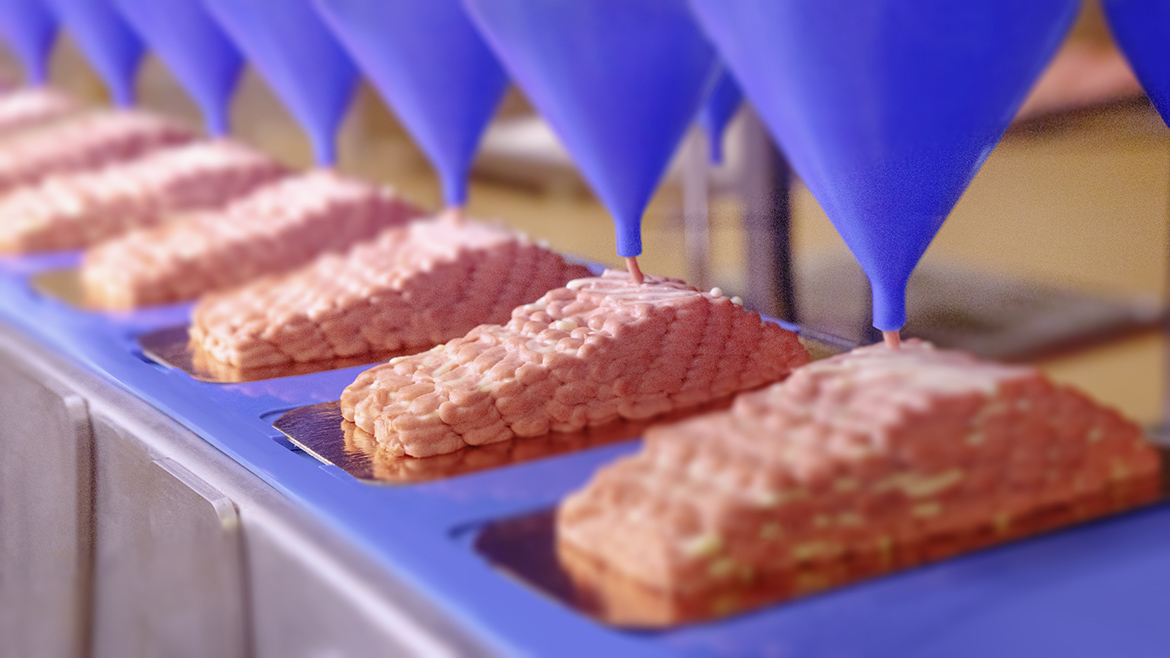
Revo Foods produces 'salmon' filets using 3D printing techniques in its Austria facility and is capable of producing several filets simultaneously with a specially designed multi-nozzle printer. Photo courtesy of Revo Foods
Regarding the hardware, this machine uses basic XYZ cartesian kinematics with stepper motor linear modules, well known in the world of 3D printing, Renaudin adds. The real hardware "challenge" is regarding the extruding technology, which answers the problem of how to get an accurate extrusion across multiple printing heads from a single feeding tank. This involves a lot of prototyping, simulations and tests to come up with the right solution — from screw extruders to a positive-displacement pumping system.
Regarding the software part, Renaudin says the process is relatively close to standard FDM plastic 3D printers. "We first design our product using 3D modelling software. Then we upload this 3D design as an STL file into our in-house developed slicer program, which will convert the 3D model into a code called ‘G-code,’ which can be read by the machine to be put in motion. We then have directly mounted on the machine a screen control board based on Klipper (a standard in 3D printing) to adjust parameters while printing (speed, extrusion rate, positions. etc.)"
If you make specialty, high-end chocolates, you may be familiar with byFlow equipment. "At byFlow, our work in additive food manufacturing is best illustrated through our latest system, the OPUS 3D Chocolate Shaper, a production tool designed specifically for chocolatiers/chocolate manufacturers, pastry professionals, e-commerce businesses, food R&D teams and premium catering environments," says Nina Hoff, founder and CEO.
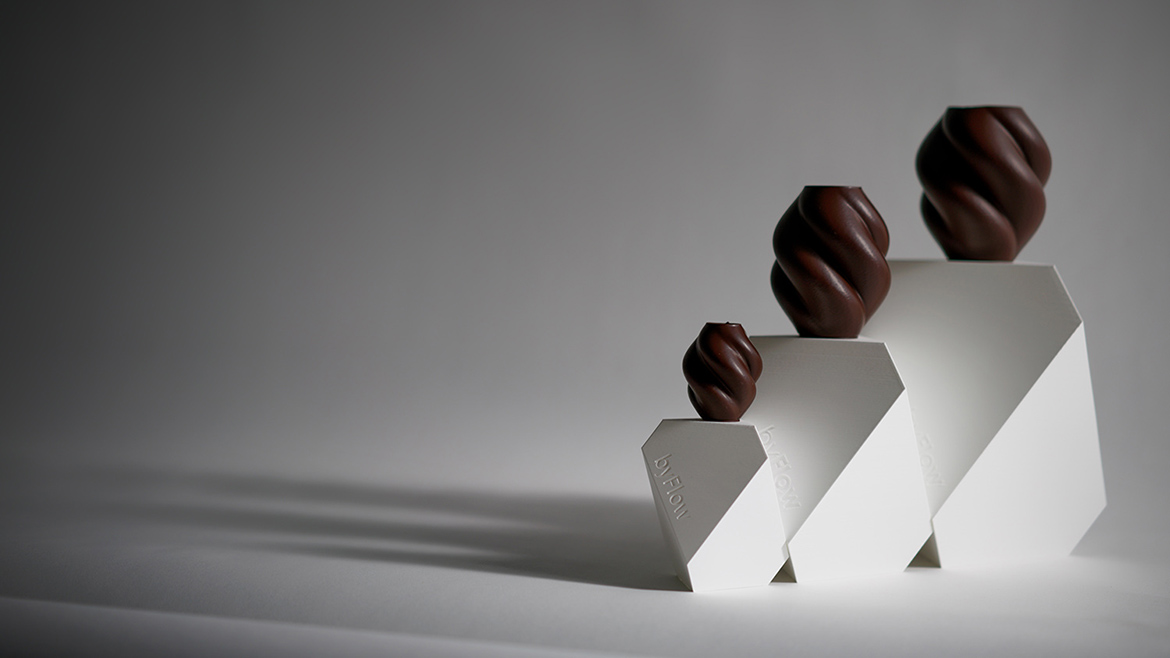
While you might be able to mold these chocolates, the creases from the mold would show. When using byFlow’s OPUS, however, these special geometric shapes look pristine, able to command a higher price. Photo courtesy of byFlow
OPUS is not positioned as a traditional 3D printer. "Instead, we developed it as a digital chocolate shaping platform, because our industry partners increasingly view additive technology as a way to enhance production workflows rather than as a novelty printing process," Hoff says. "The system combines precision motion engineering, embedded temperature control and our patented printhead technology (protected in both the EU and the United States) to ensure that shaping and tempering of chocolate happen simultaneously."
Beyond the hardware itself, byFlow provides system design support, workflow integration and a dedicated software environment called byFlow Studio+, which allows users to move from digital design to finished chocolate products within minutes.
Traditional chocolate production often relies on mold development cycles or manual decoration skills that can take weeks, months or even years to master. With OPUS, these steps are translated into a digital workflow, enabling professionals, regardless of prior design experience, to create precise, repeatable chocolate shapes quickly and reliably.
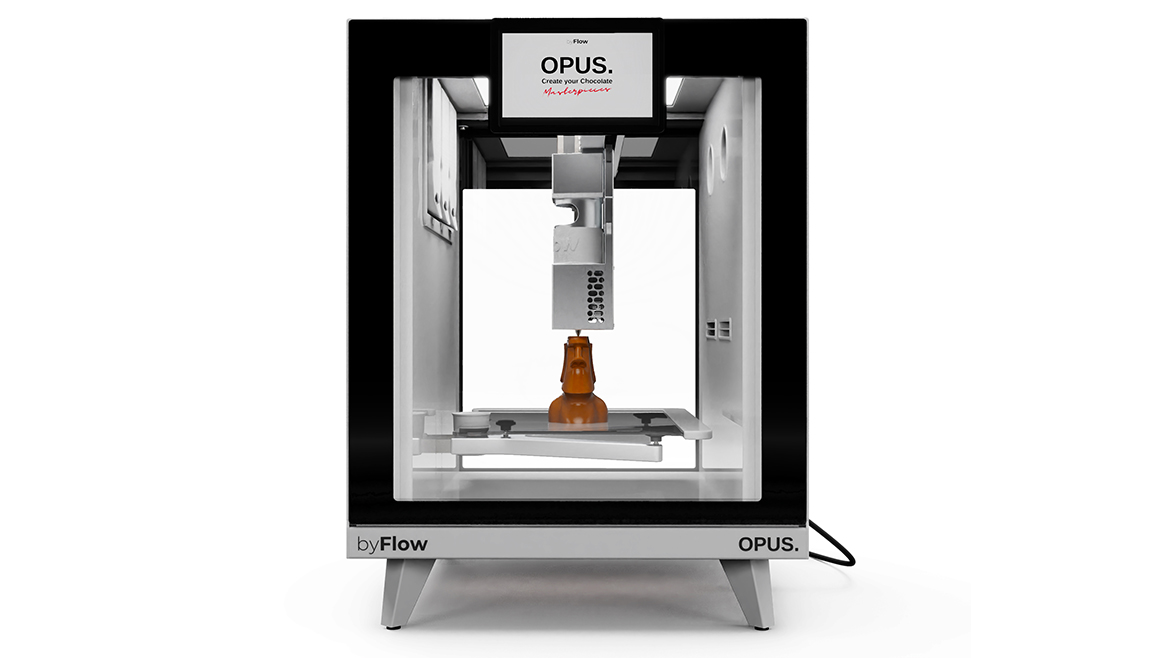
High-end, customized chocolates are created with byFlow’s OPUS 3D Chocolate Shaper. Photo courtesy of byFlow
This unique combination of hardware engineering and embedded software transforms complex processes into accessible production tools, while maintaining the level of control and consistency required in professional chocolate environments, Hoff says.
Robotics as Additive Manufacturing
While robotics isn’t generally thought of in the same way as 3D printing, a pick-and-place food assembly cell can certainly build meals and the like — not by taking away — but by adding ingredients to a meal tray or pizza, analogous to how a robotic pick-and-place machine places electronic components (chips, coils, resistors, capacitors, etc.) on a printed-circuit board.
Chef Robotics, featured in the July 2024 edition of FE, uses robotics cells to build meals with adding ingredients to trays as specified with digital code. When labor is scarce, this AM system may be a solution to building consistent meal trays or pizza. Chef Robotics recently teamed up with JBT Marel’s Proseal to provide a joint solution for meal assembly, allowing processors to automate the assembly and packaging of fresh and frozen RTE and ready-to-cook meals.
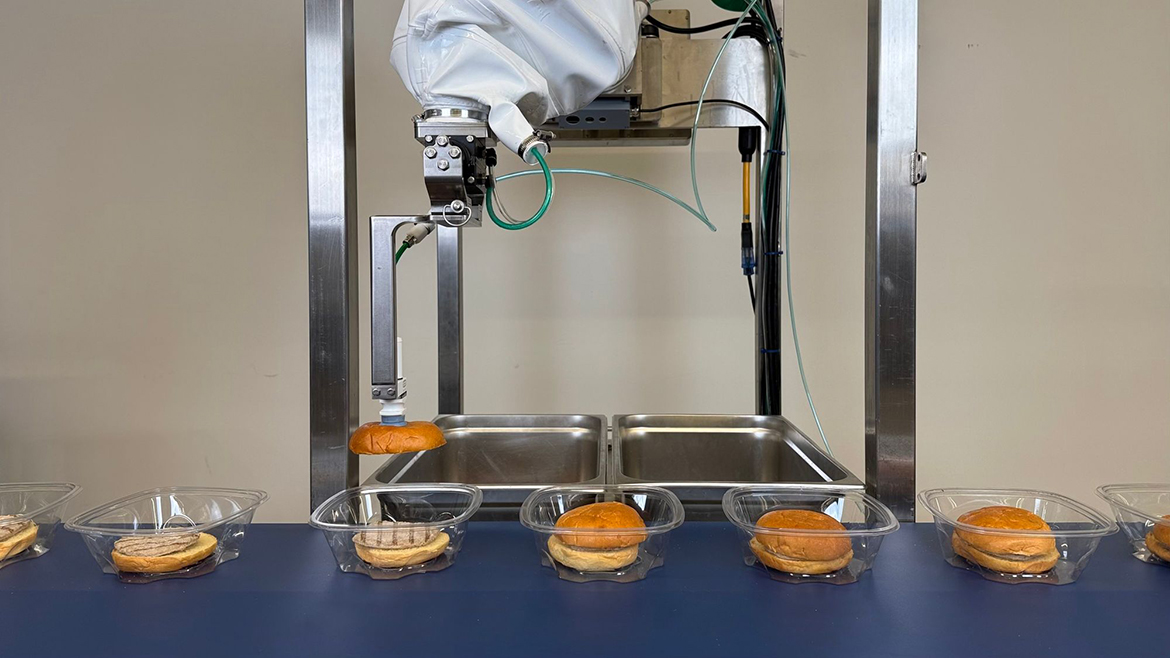
Chef Robotics also offers a piece-picking capability, where robots can segment, pick and place ingredient pieces — for example, building a hamburger. Photo courtesy of Chef Robotics
While building meal trays involves scooping ingredients from a pan and portioning them by weight or volume into the trays, Chef Robotics also offers a piece-picking capability, where robots can segment, pick and place ingredient pieces —for example, building a hamburger one piece at a time, e.g., bottom bun, burger, slice of cheese and tomato and top of bun.
While a company like Chef Robotics can orchestrate the robotics in a work cell to build a meal or pizza, robotics manufacturers like KUKA have the right people to help put the cell together. "KUKA Robotics relies on the services of our system partners for the installation, setup and programming of robotics systems; however, we offer several robotic arms and software-based technology packages for ease of implementation in the food handling space," says Rich Parkhurst, business development manager for food/beverage/consumer goods.
"From a robot arm perspective, we offer a full line of hygienic oil variants of our robots, which use NSF H1 class lubricants for safe use in food handling applications," Parkhurst says. The hygienic oil technology is offered in 6-axis, SCARA and delta form factors. In addition, KUKA offers its "hygienic machine" model of delta robot, which has a fully stainless-steel construction with an IP67 rating for the complete system and IP69K for axis 4.
"From a software perspective, our technology options create an environment for the programmer to configure the operation rather than write complex code," Parkhurst says. "These options include our KUKA.ConveyorTech solution for product tracking and robot coordination on a moving conveyor, KUKA.VisionTech for 2D object recognition and orientation and KUKA.PickControl, which is used to orchestrate up to 10 robots to combine the product tracking and robot load distribution functions on high-speed conveyors."
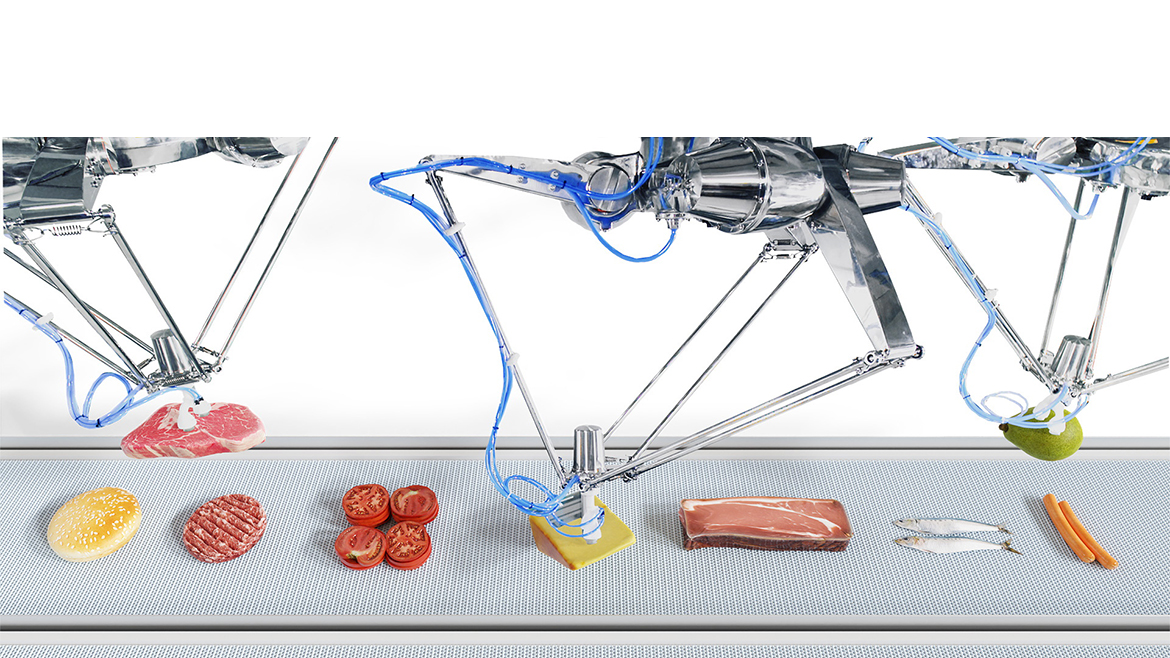
With the right end-of-arm tooling, delta-style robots can work in a cell to package or build food trays and have the ability to handle up to 6 kg payloads. Photo courtesy of KUKA Robotics
The Difference Between 3D Printing and Robotic Cells for AM
While both technologies can qualify for the definition of "additive manufacturing," there is a key difference. "Where robotic work cells excel in assembling discrete components, such as sandwiches or prepared meals, OPUS focuses on material transformation itself," says byFlow’s Hoff. "Instead of assembling ingredients, it reshapes chocolate directly into functional and aesthetic structures."
This distinction is important, Hoff says. "Robotic work cells typically require significant integration, programming and physical infrastructure. OPUS, by contrast, is designed as a standalone, yet expandable system that can be introduced into existing production environments in factories or R&D labs without extensive facility modifications. The advantage is flexibility. Users can move from prototyping to small-to-medium-scale production using the same platform, bridging the gap between creative development and commercial application."
While food assembly operations do mimic typical product assembly and case packing, what makes these applications challenging is the variability of product size, shape, texture and density, says KUKA’s Parkhurst. "I have worked with a catering end-user in the concept and testing phases of this type of application and there were two things that were obviously going to affect the level of success of the application. The first was designing the final product to align with the concept of automated assembly and packaging. By using standard sized cuts of product and limiting use of products with large variabilities, it makes the process simpler to implement and still deliver a high-quality product to the consumer with higher throughput, and in some cases, more consistent quality. The second important item was the end-of-arm tooling. In food handling applications, we cannot just use a simple, rigid gripper or we risk damaging the products. Locating the right style gripper technology for picking and placing of fragile and odd-shaped foods becomes a major area of design research and testing."
Moving from prototyping to production is relatively easy in 3D printing, but robotics present challenges. "One perceived disadvantage is the artistic aspects of food preparation and plating," Parkhurst says. "Top chefs are well known for not only the taste and overall quality of the plate but also the aesthetic aspects. Robots and automation are not conducive to ‘on-the-fly’ tweaks to the assembly and appearance of a plate of food."
Could combining robotics with 3D printing offer some new potential? Maybe, thinks Revo Foods’ Renaudin. "Till now we have relied entirely on ourselves to produce our products, so we have not yet collaborated with partners using robotic work cells, but it would be really interesting for us to take a look at this in the future."
3D Printing Applications for Food
The real advantage of 3D printing in food manufacturing is the freedom of shape and texture for your printed products, says Revo’s Renaudin. "By playing on the design of the product, you can introduce shape and texture, which would not be possible with a standard extrusion process. However, it is true that 3D printing will be slower than standard manufacturing processes — that´s why a lot of industrial [users] still refuse to believe in it, but with our current machinery we already brought an industrial output to the game with eight products being printed at the same time within five minutes. And this development was made in a range of two years with startup and limited resources, so imagine what we can do as we grow as a company."
Just like printing 3D parts at will, byFlow’s OPUS 3D Chocolate Shaper demonstrates where additive manufacturing adds real value in food production: personalization, geometric freedom and sustainable production, Hoff says.
"As consumer expectations evolve rapidly, chocolatiers and chocolate manufacturers are increasingly challenged to respond to shorter product cycles, seasonal launches and personalized offerings," Hoff says. "Many existing production systems are optimized for stability and scale, but lack the flexibility to switch quickly between designs or product variations without significant cost or downtime. This has created a growing demand for accessible, adaptable technologies that allow producers to react faster to market trends while maintaining consistent quality."
Digital chocolate shaping addresses this shift by enabling rapid changeovers through software rather than hardware reconfiguration, allowing professionals to move between designs, geometries and applications without relying on new molds or complex production adjustments, Hoff says.
Typical applications for the OPUS 3D Chocolate Shaper include:
- Personalized chocolate bars and decorations for in-shop experiences, e-commerce and corporate gifting
- Automation of manual decoration processes
- Limited-edition or seasonal chocolate products
- The creation of shapes that traditionally require expensive molds or are simply impossible to mold
While additive systems are often described as robotically driven extrusion heads moving along X, Y and Z axes, the real engineering complexity lies in material control. Chocolate requires precise tempering to achieve gloss, structure and stability. OPUS integrates tempering and shaping directly within the same workflow, ensuring consistency without separate tempering steps or external supply systems.
The advantages are clear: reduced tooling, rapid design iteration and minimal material waste, Hoff says. The primary limitation today is throughput for extremely high-volume commodity products, where traditional molding lines still dominate. However, in premium and personalized segments, shaping-based automation fills a growing gap between manual craftsmanship and industrial production.
OPUS supports batch-based workflows where multiple products can be shaped within a single design environment, allowing professionals to optimize layouts and production sequences digitally.
Simulation: Key to Developing Applications
Whether you use robotics cell applications or 3D printing, simulation is key to discover if there are any potential glitches in production.
"Along with the design phase of our machines, we always run tests and simulation to validate their feasibility, confirmed later or not with prototyping," says Revo Foods’ Renaudin. "Once a prototype is validated, we then estimate their cost effectiveness and ROI, however, it is also very dependent on the acceptance of the products by the consumer and the reality of the market. Regarding the modularity of our system, yes, it is modular, number of materials printed can be adjusted, number of printing heads too, the size of the products also etc.… Moreover, by using parametric design 3D modelling software, we can easily adapt our machines to different set-ps and configurations."
"Robotic cell feasibility testing can most definitely be taken advantage of in a simulated environment to test general function and estimate throughput/ROI. However, I do recommend doing physical testing on primary food handling applications with the proposed ingredients as most simulation tools cannot replicate the variabilities of primary food handling," says KUKA Robotics’ Parkhurst. "While there are standardized robotic solutions for common food preparation, many are custom and require a combination of simulation and physical testing before settling on a design and moving to production."
"One of the strongest benefits of digital shaping with OPUS is that workflows can be planned and visualized before production begins," says bvFlow’s Hoff. Designs are created in software, production sequences are defined digitally and accurate material usage can be estimated ahead of time.
"We are always working to continue to improve the workflow from idea to reality," Hoff adds. "It’s much easier to adapt the software than changing hardware as we can continuously improve the capabilities of the machine. To enable this, we have made a modular hardware system with full custom, in-house developed electronics to enable all the software improvements. The machine that a customer buys today can do things better (or something different) than it could with almost monthly new improvements.
"Food processors sometimes approach additive manufacturing with expectations shaped by consumer-level technologies. In professional chocolate production, however, the conversation quickly shifts toward reliability, maintenance and return on investment. The OPUS platform addresses this by combining modular hardware with embedded software tools, making setup more accessible compared to fully custom robotic integrations."
Resources:
"New dimensions in dining - A review of the gastronomic evolution of 3D Printed Foods from 2013 to 2024 and beyond," International Journal of Gastronomy and Food Science, Volume 38, December 2024, 101027, Róisín M. Burke
"3D Food Printing Commercial Equipment Market Size & Share 2025 – 2034," Global Market Insights, Website
"Executive summary: 3D printing technologies in the food system for food production and packaging," Food Standards Agency, UK. (Complete Project).
Looking for a reprint of this article?
From high-res PDFs to custom plaques, order your copy today!



-Photo-by-Clay-Banks-on-Unsplash.webp?height=200&t=1692630940&width=200 "Hands with gloves on")

