Automation
Simplifying the Alphabet Soup of Industrial Networks
Today’s open-standard industrial networking has come a long way from all the proprietary systems of the past, reducing costs and setup time.
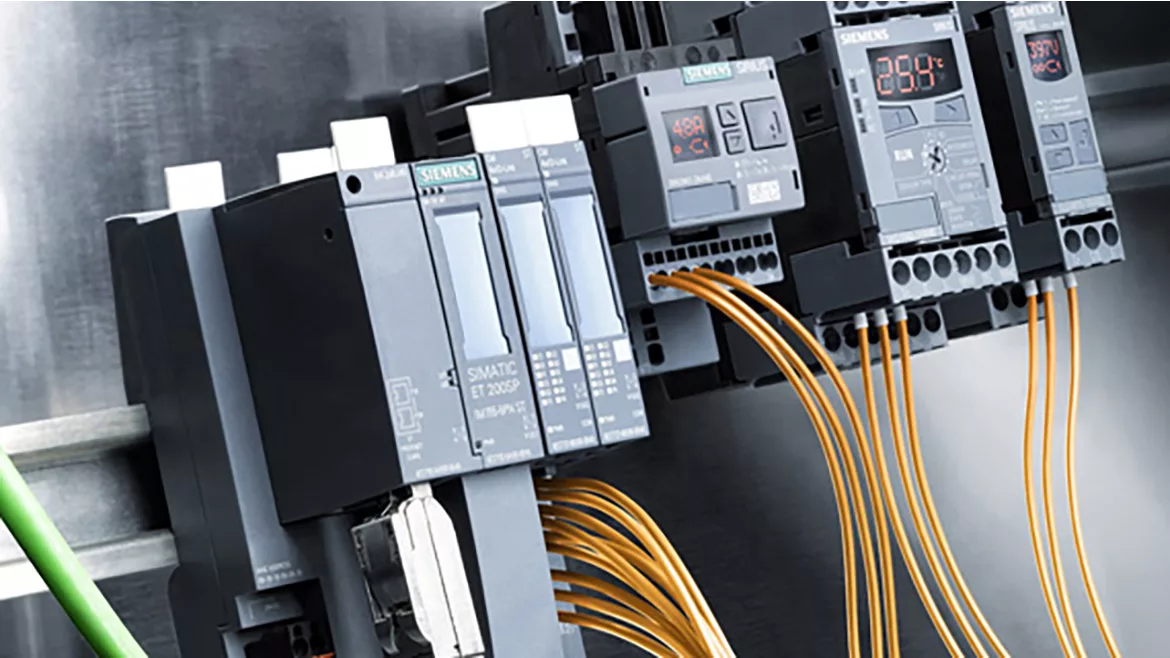
The open communication standard IO-Link gives you access to all field data and optimally integrates the growing intelligence of sensors and actuators into your automation system.
Today’s Industry 4.0 devices need to communicate to provide actionable information to plant operators and management. That’s become easier today, thanks to open standards for industrial networks.
While there are still some vendor-specific and proprietary protocols/networks/wiring available, it’s been in everybody’s interest to work toward and provide open-standard, vendor-agnostic (neutral) protocols and networking/wiring/connector types. Some of these in no particular order include TCP/IP, MQTT, OPC UA, Ethernet-APL, HART, AS-i, IO-Link, EtherNet/IP, PACK-ML and others.
This article looks at some of the major protocols/communication options in use today. For processors who have employed system integrators and engineering houses to design and build their systems, the use of vendor-neutral and open-standard protocols can not only lower the cost of tying various automation vendors’ equipment together but also speed up project completion.
From Analog to Digital
In the beginning and before digital networking, analog-based sensors and actuators used the ubiquitous, industry-standard 4-20 mA current loop, which was incapable of handling more than one process variable. Today, there is a digital solution to this problem — HART on the 4-20 mA wire pair.
“Far and away, the most popular product used in the process automation industry is the 2-wire, 4-20 mA current loop, which is generally coupled with the HART (Highway Addressable Remote Transducer) communication protocol,” says Paul Sereiko, FieldComm group director – marketing and product strategy. “HART technology has been available for nearly 30 years, and over 40 million devices supporting the protocol are deployed worldwide. The biggest advantage of HART over 4-20 mA is simplicity. As long as the current loop is active, process variables needed for control are available, and HART data can be read by higher level systems like asset management applications… The biggest disadvantage is speed. At 1200 kbs, the HART signal operates at the same speed as a dial-up modem, making it very challenging to acquire meaningful amounts of actionable digital data for use outside the control environment.”
HART remains a dominant protocol in the industrial market, but there is a quickly expanding number of installations and applications of Ethernet-based protocols like EtherNet/IP and PROFINET for process automation, says Jason Pennington, Endress+Hauser USA, director of digital solutions. “At the field network level, IO-Link is growing rapidly. HART is widely known and relatively simple to install on both conventional and modern instruments, while Ethernet-based protocols and IO-Link require more specialized networking equipment and know-how.”
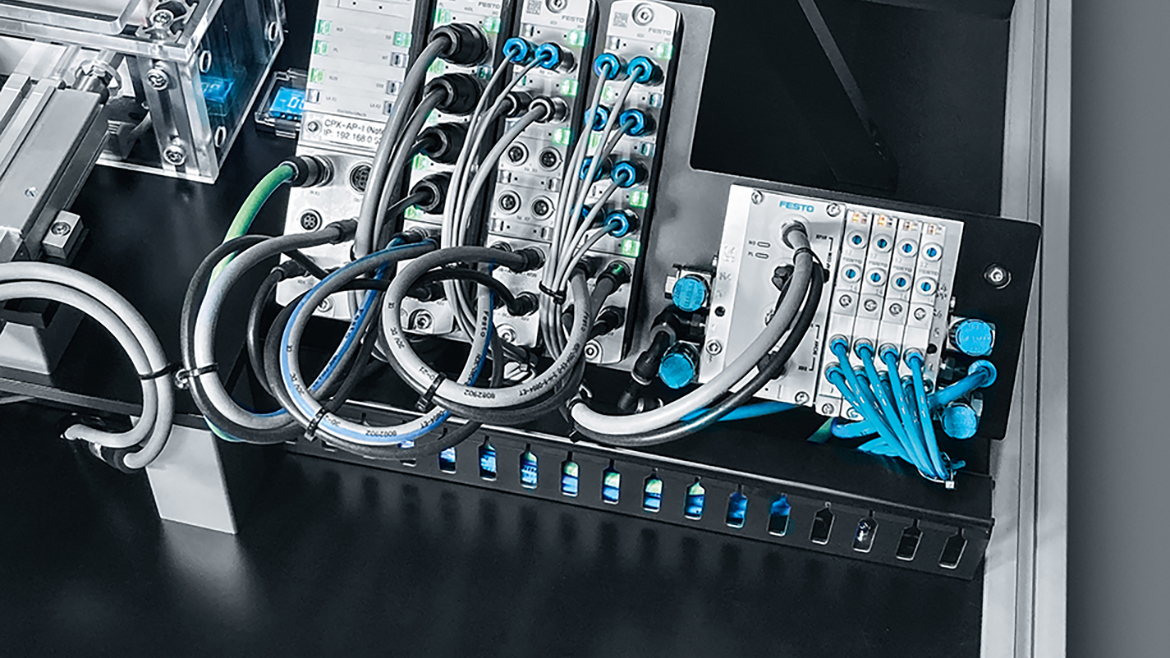
The physical layer for industrial Ethernet connections did away with the RJ45 connectors, which were prone to breakage and loose connections, and replaced them with more sturdy connectors such as the M12-D and others. Shown is Festo’s AP-I IO-Link system with VT and I/O. Photo courtesy of Festo
Open and Closed Standards
Network protocols generally fall into three categories: industry standards, open standards and vendor proprietary, according to Roy Kok, Mitsubishi Electric Iconics Digital Solutions product marketing manager. Industry standards are defined and maintained by recognized standards bodies. Open standards often begin as vendor-developed protocols that are later made available for broader adoption. Vendor-proprietary protocols are captive to a specific vendor’s architecture and product ecosystem.
Examples of each category include:
- Industry standards: BACnet, SNMP, OPC UA, MQTT, AMQP, IO-Link
- Open standards: CAN, Modbus, EtherNet/IP, CC-Link, Profinet, EtherCAT
- Vendor Proprietary: Fanuc FOCAS, DF1, MelsecNet, Sinec H1
Wire-based network types range from simple twisted pairs to Ethernet and fiber optic cabling. Selection is typically based on cost, convenience or performance requirements. Twisted pairs are usually the most cost-effective option. Ethernet is commonly selected for convenience, and in environments with high electrical noise or demanding performance conditions, optical fiber is often preferred.
Some protocols are designed specifically for harsher environments. IO-Link, for example, supports pre-terminated cables that provide strong noise immunity and environmental protection, with ratings ranging from IP65 to IP69.
“Regardless of the protocol selected, most now support client connectivity through OPC UA, the industry standard. Control networks may still communicate using native protocols, but interfaces to higher-level systems are increasingly handled through OPC UA, which adds standardized naming conventions and contextual information to facilitate data consumption,” Kok says.
“Current industry specifications increasingly prioritize vendor-neutral protocols such as IO-Link, EtherNet/IP, EtherCAT and OPC UA,” says Russell Weekley, Gray AES director, automation. “IO-Link has gained significant traction for its use of cost-effective, standardized cabling and its support for seamless, plug-and-play device replacement; however, it remains constrained by a 20-meter distance limitation. In contrast, Ethernet-based alternatives leverage standard copper networking infrastructure. This convergence onto a unified physical layer simplifies installation and significantly reduces the diversity of cables, connectors and diagnostic tools required for modern fieldbus deployments.”
EtherNet/IP is a popular industrial communication network in the U.S., particularly due to its implementation by Allen-Bradley, says Carl Schmid, senior engineer, Enterprise Automation, a Control System Integrators Association (CSIA) Certified Member. Deployment doesn’t require much of a learning curve since EtherNet/IP uses and can exist simultaneously on the same media and hardware infrastructure as conventional IEEE 802.3 Ethernet. It’s also common enough that most facilities also have personnel familiar with that technology. There’s a variety of equipment available that integrates EtherNet/IP such as controllers, drives, motion control, sensors, vision systems, valves, HMI/OIT and communication gateways.
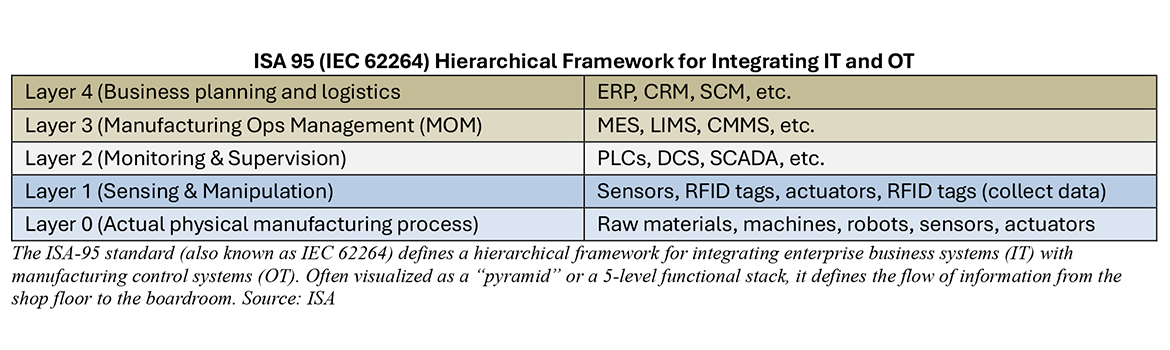
(Click on image to enlarge).
When asked what vendor-neutral protocols are on the manufacturing shop floor, Lance Fountain, global account industry consultant for Rockwell Automation responded. “Honestly, this most often depends on the age of the plant and the related automation equipment. For newer control equipment communicating up into the ISA 95 stack (L1/L2 to L4), we often see interest and adoption of EtherNet/IP or OPC UA. Ethernet-APL is also very prevalent in the process industries. For instrument/fieldbus communication (L0 to L1/L2), we are seeing protocols like IO-Link in addition to the further adoption of EtherNet/IP. In older equipment or facilities, we continue to see extensive adoption of legacy protocols, including Modbus, Profibus, HART, etc.”
At the fieldbus level, Schmid describes the actuator sensor interface (AS-Interface or simply, AS-i). AS-i is a well-established, low-level networking standard identified by IEC 62026-2. AS-i can be directly connected to controllers. Another common application is to use an AS-i Master to act as a low-cost gateway providing remote I/O to another industrial network such as EtherNet/IP, Modbus and others. The topology can be a mixture of line, ring, star or tree configurations. Each AS-i bus can provide a maximum of 1536 inputs and 1536 outputs, and a cycle time as low as 1.2 ms (with a limited number of devices), dependent on the version. The physical media consists of a flat two-conductor unshielded cable that provides both power and data for common sensors and actuators. Typically, devices are connected to the bus with insulation-displacement attachments that pierce the insulation for fast assembly. High-power devices will need an external power supply.
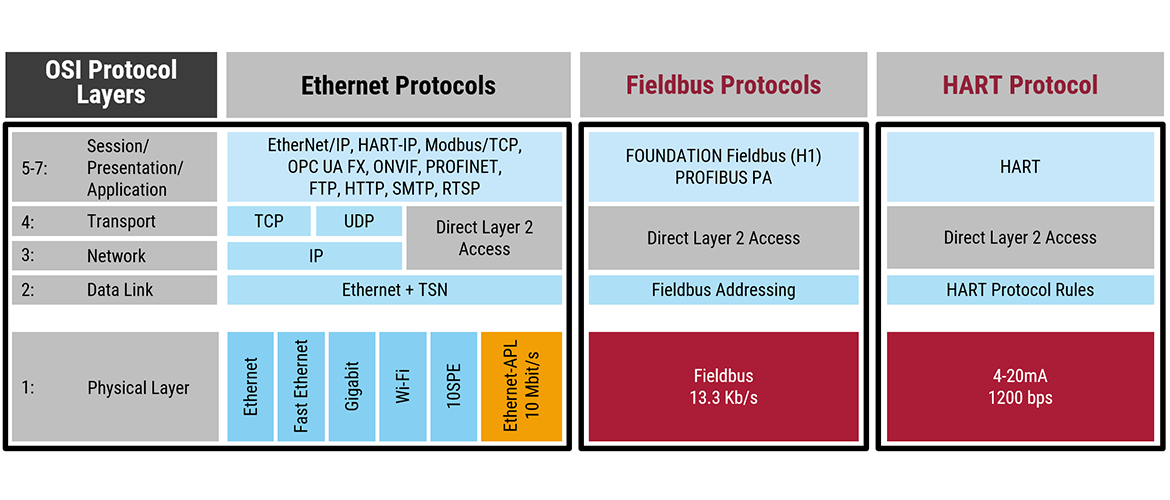
(Click image to enlarge.) Ethernet-APL is the new physical layer that provides power and data over two wires at 10 Mbit/s, enabling multi-vendor product support for devices installed in food/beverage environments and using protocols such as HART-IP, EtherNet/IP, PROFINET, OPC UA, and others. Image courtesy of FieldComm Group
“IO-Link has seen widespread adoption by manufacturers, suppliers and system integrators alike,” says Alejandro Ocampo, product manager – automation, Omron Automation Americas. “Standardized in IEC 61131-9 in 2013, IO-Link’s popularity and need is only growing. As we move deeper into a data-centric industry, the capabilities of IO-Link will further solidify its place as not an option but a requirement.”
“IO-Link has excellent support in terms of suppliers and system integrators,” says Frank Latino, Festo global product manager BU-EA. All major I/O vendors make both controller blocks and devices for IO-Link. System integrators like the flexibility IO-Link provides when used in combination with an RTE (real-time Ethernet) network. One reason is because they can have machine variances with one project and simply populate the machine control with the quantity of IO-Link blocks and devices necessary. Omitting or inserting an IO-Link block does not offset addressing with most host PLCs.
IO-Link is still growing, but new technologies like single-pair Ethernet (SPE) may overtake IO-Link in the long term. Network organizations are looking at this to make Ethernet a single network that can be used throughout the entire plant. For example, ODVA defines “constrained devices” which support fewer features, but can be deployed in a small, inexpensive format with 2-wire, powered Ethernet, Latino adds.
EtherNet/IP and Ethernet-APL: What’s the Difference?
EtherNet/IP, Profinet, Modbus TCP and EtherCAT are popular Ethernet networks based on open standard fieldbus protocols for connection of I/O devices to controllers, says Raj Rajendra, portfolio sales specialist for Siemens Industry, Inc. Copper-based Ethernet connection is common. For longer distances (can be kilometers) and noisy electrical environments fiber optic media is preferred. Copper is limited to 100 meters but can be extended with Ethernet switches that serve as repeaters. They are all two twisted-pair, 4-wire ethernet based on IEEE 802.3 standard for data transfer rates of 10/100 Mbps. These fieldbus systems support primarily discrete industries, Rajendra says.
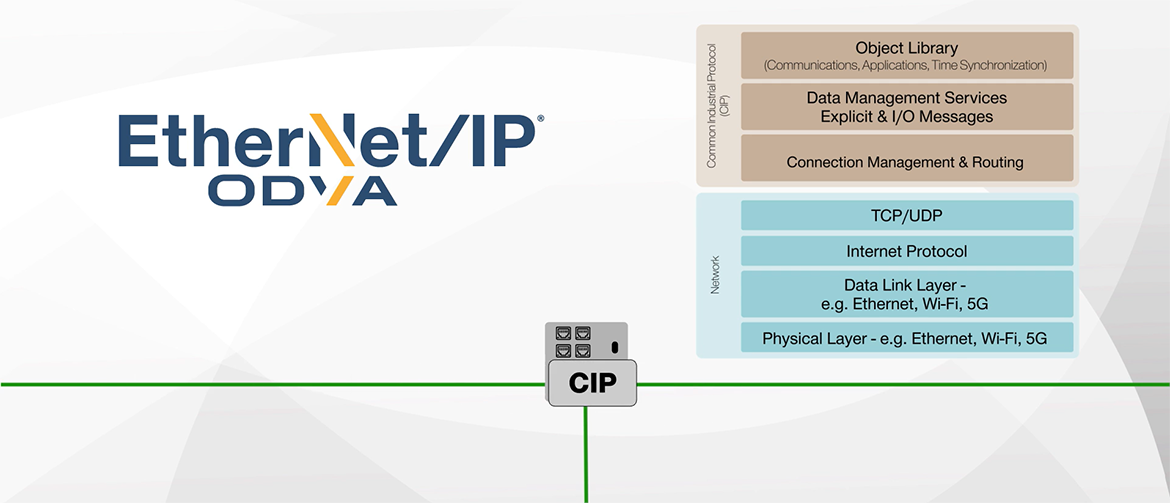
(Click image to enlarge.) EtherNet/IP is an industrial communications protocol based on CIP — and utilizing extensions for security, safety, motion and more — to provide secure, easy and seamless industrial device control and connectivity — and it can be deployed across different physical layers including wireless, fiber optics and Ethernet. Image courtesy of ODVA
Initially, the physical layer for EtherNet/IP was similar to commercial ethernet, says Festo’s Latino. RJ45 or M12-D coded connectors were specified with both Rx (receive) and Tx (transmit) twisted pairs (4 wires). Devices have common physical layer electronics designed to match typical ethernet devices.
Ethernet-APL (advanced physical layer) is a single pair Ethernet system specifically designed for intrinsically safe low-power applications in the process industries, Rajendra adds. The transmission rate is lower at 10 Mbps, and the cable length can be as long as 1,000 meters. Ethernet-APL is based on IEEE 802.3cg 10BASE-T1L standard.
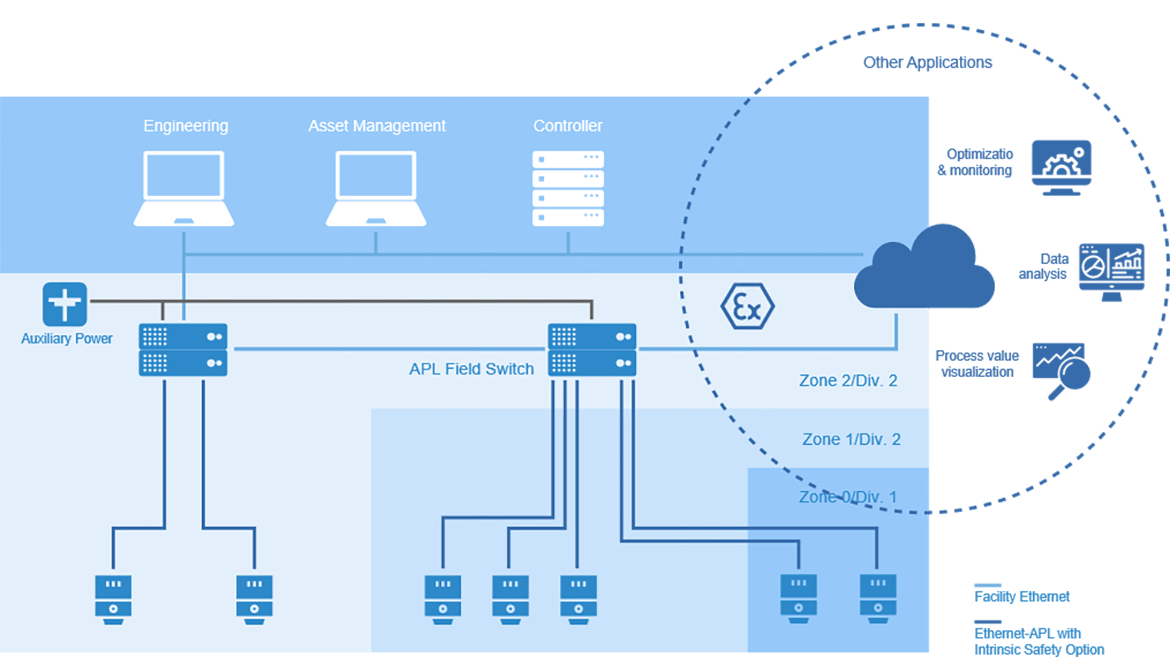
(Click image to enlarge.) Ethernet-APL is a physical layer utilizing two-wire Single Pair Ethernet — and potentially allowing the reuse of existing cable — supporting the usage of industrial Ethernet protocols for process and hybrid industries where long reach and use in hazardous areas are key. Image courtesy of ODVA
Initially, the physical layer for EtherNet/IP was similar to commercial ethernet, says Festo’s Latino. RJ45 or M12-D coded connectors were specified with both Rx (receive) and Tx (transmit) twisted pairs (4 wires). Devices have common physical layer electronics designed to match typical ethernet devices.
Ethernet-APL (advanced physical layer) is a single pair Ethernet system specifically designed for intrinsically safe low-power applications in the process industries, Rajendra adds. The transmission rate is lower at 10 Mbps, and the cable length can be as long as 1,000 meters. Ethernet-APL is based on IEEE 802.3cg 10BASE-T1L standard.
A Note on Determinism
Over the years, an important issue concerned with Ethernet communications for industrial applications has been that Ethernet wasn’t designed to be deterministic. In earlier days, deterministic network systems (e.g. token passing) may have been slower than Ethernet systems in terms of overall response time, but it was possible to know that timings around the network were fixed and predictable. Each node knew when it could “talk” because it received an invitation to talk (token). Since Ethernet systems were non-deterministic, timings were difficult to predict and made it hard to establish transmit/receive priorities. Therefore, a “chatty” node on an Ethernet network could disrupt an urgent message from an out-of-control machine or critical process.
“Determinism is an important aspect of fieldbus communications,” says Siemens’ Rajendra. “For example, Profinet offers guaranteed determinism with a jitter of less than 1µs and cycle time that is as low as 31.25 µs with clock synchronous Profinet IRT, which is proprietary. Recent development is Time-Sensitive Networking (TSN), which is a set of IEEE 802 Ethernet standards that add features for real-time, deterministic communication, allowing critical and non-critical traffic to converge on a single standard Ethernet network, ensuring guaranteed low latency, bounded jitter and high reliability for applications like industrial automation, automotive and aerospace. It achieves this through precise clock synchronization, time-aware scheduling, frame preemption and traffic shaping, making standard Ethernet suitable for control systems.”
OPC UA and MQTT: Used Together but for Different Purposes
OPC UA and MQTT solve different problems in industrial environments, and in practice, they are often used together rather than in isolation, says Matt Holman, director of operations – industrial intelligence & reliability division, Actemium Avanceon, a CSIA Member.
OPC UA is best suited for structured, secure access to operational data close to the source. A common example is an MES system connecting to multiple PLCs across a production line. OPC UA allows systems to read and write well-defined data points such as production counts, quality results, recipe parameters and equipment states, using strong security and standardized data models. In this role, OPC UA provides trusted, contextualized data directly from the control layer to systems that require a detailed understanding of process and equipment state.
MQTT, by contrast, is optimized for efficient data distribution at scale. A typical use case is publishing production, quality and performance data from multiple lines or plants into a centralized data platform or analytics environment. With MQTT, data can be published once and consumed by many systems simultaneously, such as dashboards, reporting tools, advanced analytics platforms or cloud services, without tightly coupling those consumers to the original data source, Holman says.
In many Industry 4.0 architectures, both technologies are used together, Holman says . “OPC UA is often used to securely extract and contextualize data from PLCs or MES systems at the plant level. That data is then published via MQTT into a Unified Namespace, where it becomes available to multiple downstream consumers across the enterprise. This approach preserves data integrity and structure at the source while enabling scalable and flexible data distribution.”
Think of OPC UA as tagged-based, whereas MQTT is built on a “publish and subscribe” model that is standardized on packets of information, says E+H’s Pennington. OPC UA can operate at higher speeds with rich data models where MQTT is often configured for event-driven, compact messages, which are common in cloud and hybrid architectures.
With MQTT data is transferred through a broker, says Festo’s Latino. This is very flexible since most systems can exchange data through the broker. It is also very lightweight, and easy to implement in a small controller, including other applications.
MQTT requires an accompanying data format and context standard, says Mitsubishi’s Kok. Sparkplug B is an open Industrial IoT specification developed by the Eclipse Foundation that defines how industrial data is structured, named and managed when transmitted over MQTT. Sparkplug B addresses this requirement by defining a standardized payload, topic structure and state management model for industrial data
Looking ahead, Holman says, OPC UA will continue to play a critical role in OT environments due to its security model, standardization and growing ecosystem of companion specifications. MQTT-based technologies will continue to expand as manufacturers scale their use of data beyond the plant floor, particularly for enterprise analytics and cloud-connected applications.
Resource:
“What Sensor Companies Are Moving to and Why You Should Care,” FE, Sept. 2022
Looking for a reprint of this article?
From high-res PDFs to custom plaques, order your copy today!