How Conveyor Monitoring Can Cut Costs, Prevent Downtime in Food Manufacturing
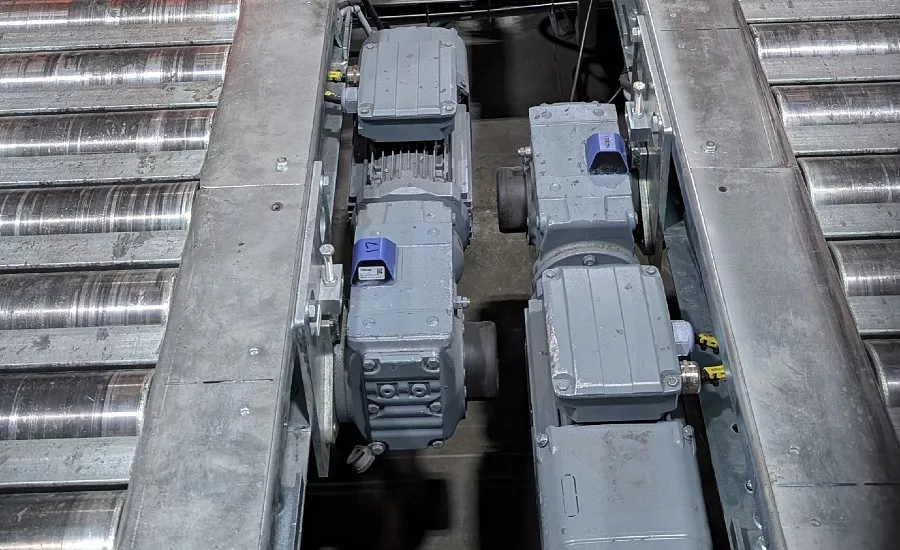
Wireless vibration and temperature sensors (blue) attached to conveyor gearmotors constantly collect condition data and send it to the cloud for AI-driven analytics.
Unplanned downtime remains one of the most persistent and expensive challenges in food manufacturing. In a recent FOOD ENGINEERING article, Editor-in-Chief Alyse Thompson-Richards posed a simple but urgent question: How much is downtime costing you? The answer, according to industry research, ranges widely from $10,000 to $500,000 per hour.
For food manufacturers operating high-volume, tightly synchronized production lines, even short interruptions can have an outsized impact. Lost production, wasted raw materials, missed delivery deadlines and potential compliance risks all compound the cost of a single failure event.
At the same time, manufacturers recognize that reactive maintenance strategies are no longer sustainable. Companies that invest in forward-looking life-cycle strategies report fewer failures and greater resilience. Yet despite clear benefits, many organizations struggle to justify the high upfront costs associated with preventive maintenance investments.
This tension between the need for reliability and the pressure to reduce costs has forced manufacturers to rethink where and how to begin their preventive maintenance journey. Increasingly, the answer lies in an unexpected place: conveyor systems.
Principles of Preventive Maintenance
Modern food manufacturing depends on a highly complex network of assets. Motors, gears, pumps, compressors and processing equipment operate continuously under demanding conditions. Each component represents a potential point of failure.

Preventive maintenance aims to detect early warning signs before failures disrupt production. Its effectiveness, however, depends on how well maintenance resources are allocated. This is where the concept of asset criticality becomes essential.
Asset criticality evaluates two factors: the likelihood that an asset will fail and the consequences if it does. Together, these variables determine how critical an asset is to the overall production process.
In most facilities, assets fall into three categories:
- High-criticality assets (Level 1/Category A) are essential to operations and often represent single points of failure. Their breakdown leads to immediate production stoppages, significant financial loss and potential safety or regulatory concerns. Examples include primary processing systems and main production conveyors.
- Medium-criticality assets (Level 2/Category B) support production but are not solely responsible for keeping it running. Failures typically cause localized disruptions or reduced efficiency rather than a full shutdown. Packaging systems, ventilation equipment and secondary conveyors fall into this category.
- Low-criticality assets (Level 3/Category C) have limited impact on core operations. Failures are usually manageable through quick replacement or temporary workarounds. These include auxiliary systems, smaller motors and non-bottleneck conveyors.
While this framework helps guide maintenance strategies, it also reveals a critical challenge: the vast majority of assets in a typical facility fall into the lower criticality categories. Individually, they may seem insignificant. Collectively, however, they represent a major source of operational risk.
Why Conveyors Matter More Than They Appear
Conveyors are the backbone of food manufacturing operations. They transport raw materials, intermediate products and finished goods across the production line, linking every stage of the process.
Unlike many other assets, conveyors cut across all levels of criticality. Some are central to production continuity, while others play supporting roles. Yet their interconnected nature means that a failure in one section can quickly ripple across the entire system.
A stoppage in a downstream conveyor, for example, can cause upstream bottlenecks, forcing operators to slow or halt production. Even minor disruptions can escalate rapidly, creating a cascade effect that impacts throughput, efficiency and product quality.
What makes conveyors particularly important is not just their function, but their scale. In large facilities, conveyor systems can span hundreds of meters and include dozens or even hundreds of motors, gearboxes and other rotating drive components.
This scale introduces a paradox: conveyors are both essential and difficult to manage. Critical to production, they are driven by hundreds of simple rotating equipment. Their distributed nature makes conveyors challenging to monitor effectively using conventional approaches.
The Hidden Nature of Conveyor Failures
One of the most significant challenges in conveyor maintenance is that failures rarely occur suddenly. Instead, they develop gradually, often starting as small, nearly invisible changes within components such as motors and gearboxes.
Common early-stage issues include belt misalignment, subtle increases in vibration, rising friction and contamination from moisture, sugar, fat or dust. Over time, these small deviations compound, leading to reduced efficiency and eventual failure.
Operators may not detect these issues during routine inspections. In many cases, the system continues to operate, seemingly normally, until the problem reaches a tipping point. At that stage, the resulting failure can be disruptive. This gradual progression makes conveyor failures particularly costly. What begins as a minor, easily fixable issue can evolve into a major production interruption if left unaddressed.
The Limits of Traditional Maintenance Approaches
Traditional maintenance practices are not well suited to detecting these subtle, early-stage problems, especially in large conveyor systems. Manual inspections, while valuable, are inherently limited. Maintenance teams cannot continuously monitor every motor and gearbox across long conveyor lines. Periodic checks may miss issues that develop between inspection intervals.
SCADA systems and process alarms provide another layer of monitoring, but they typically focus on operational thresholds rather than mechanical condition. As a result, they may not detect anomalies until performance is already affected.
Meanwhile, traditional condition-monitoring systems are typically designed for high-value assets and can be too complex and expensive to deploy at scale across large fleets of relatively low-cost components such as conveyor drivers. The result is a blind spot in maintenance strategies. Small but critical issues in conveyor systems frequently go undetected, allowing them to accumulate over time. Ironically, these “low-value” assets often pose a high risk to overall production stability.
Scaling Predictive Maintenance Across Conveyor Systems
To address this gap, manufacturers must rethink how predictive maintenance is applied to conveyor systems. The goal is to achieve a reliable, system-wide visibility in a cost-effective way.
This requires a scalable approach built on three key capabilities:
- Continuous condition monitoring of rotating components
- Centralized data collection and analysis
- Actionable insights that enable proactive maintenance actions
At the core of this approach are sensors that measure vibration and temperature, the key indicators of mechanical health of rotating equipment. To achieve complete, reliable and real-time visibility to the conveyor operations, each of the equipment must be monitored with a dedicated sensor. By tracking how these metrics change over time, it becomes possible to detect deviations from normal operating conditions and identify emerging issues before they escalate.
Making Predictive Maintenance Cost-Effective
One of the main barriers to adopting predictive maintenance has been cost. However, recent technological advances have made it possible to deploy effective solutions without the heavy investments traditionally required. Several factors play a critical role in reducing costs:
Cloud-Based Infrastructure
Cloud platforms eliminate the need for on-premises servers and complex IT infrastructure which typically come with a long implementation time, high upfront investment and various recurring lifecycle costs. The cloud can reduce the overall costs, accelerate deployment and provide scalability to grow.
Fit-for-Purpose Sensors
Conveyor monitoring does not require highly specialized or overly complex sensors. In most cases, a combination of temperature measurement and vibration analysis, specifically acceleration and velocity (RMS), is sufficient. A frequency band of 1kHz provides ample anomaly detection capability. The IP69 industrial design grading gives proper protection against dust, water, and other impurities such as sugar and fat.
By focusing on essential capabilities and avoiding over-specification, manufacturers can significantly reduce hardware costs without compromising performance.
Wireless Technology
Wireless sensors simplify installation, particularly when covering large conveyor systems in complex facilities. They eliminate the need for extensive cabling, reduce installation time and lower lifecycle maintenance costs. This is especially important for conveyor systems, where physical accessibility can vary and retrofitting wired solutions can be expensive.
Artificial Intelligence
Artificial intelligence (AI) has become a key enabler of scalable predictive maintenance. Modern systems use self-learning algorithms to establish baseline operating conditions for each asset. At the beginning of its operation, the system learns what “normal” looks like and can automatically detect anomalies in the future. This eliminates the need for manual configuration and reduces dependence on specialized vibration expertise. AI-driven analytics also can trigger real-time alerts automatically, enabling maintenance teams to act.
In an industry where margins are tight and production efficiency is critical, unplanned downtime is a risk that manufacturers cannot afford to ignore. At the same time, the path to predictive maintenance does not have to begin with large, complex investments. Conveyor systems, often overlooked and underestimated, offer a practical and scalable entry point.
By focusing on these systems, manufacturers can address a major source of hidden risk while implementing cost-effective monitoring solutions. With the right combination of wireless sensors, cloud infrastructure and AI-driven analytics, it is possible to achieve comprehensive visibility without prohibitive costs. The result is a more resilient operation where problems are identified early, disruptions are addressed proactively, and production flows smoothly.
Looking for a reprint of this article?
From high-res PDFs to custom plaques, order your copy today!