Case Study
How Pearl Crop Turned to Rented Robots to Combat Seasonal Labor Concerns
For food processors handling seasonal harvests, efficiency challenges often arrive all at once. Raw ingredients flood facilities during a narrow harvest window, production schedules tighten and labor-intensive tasks can become critical bottlenecks.
For Pearl Crop, a processor of nuts and seeds based in California, those pressures prompted a search for a more flexible automation strategy, ultimately leading the company to explore a robot rental model rather than a traditional capital equipment purchase.
Founded in 2007, Pearl Crop is a third-generation, family-owned operation with deep roots in the industry. The company provides a range of processing services, including roasting, seasoning, nut butter production and packaging.
Processing more than 100 million pounds of nuts and seeds each year, the scale of Pearl Crop’s operation underscores its challenge. Despite year-round production, the entire year’s harvested product is received within just a two-month period.
That concentrated influx of raw materials creates a familiar problem across many food manufacturing sectors: finding enough workers for demanding, repetitive material-handling jobs during peak periods. At Pearl Crop, management identified manual case handling as one of the most significant operational pain points.
The biggest challenge is finding the right employees for the repetitive and difficult work, which includes picking and stacking boxes that weigh up to 50 lbs. for much of a shift. Those physical demands of the job also have implications for worker fatigue and safety.
Like many processors facing labor shortages and rising throughput demands, Pearl Crop began evaluating automation not simply as a technology upgrade, but as a way to remove production constraints.
"We realized that there is going to be efficiency issues in the bottlenecks, the manual labor, and in order to increase our throughput and increase our efficiency, we have decided to look into automation," says Pearl Crop Founder and CEO Ulash Turkhan.
Yet adopting automation is rarely straightforward, particularly for seasonal food processors. Traditional automation investments often require substantial capital commitments, lengthy procurement timelines and confidence that equipment will remain fully utilized year-round. Those realities can make automation difficult to justify for facilities with fluctuating production demands.
This challenge created an opportunity for RentoRobot, a company built around an equipment rental model for industrial automation that addresses one of the industry's pressing concerns: timing.
In fast-moving food operations, waiting months for equipment can mean missing an entire production season.
RentoRobot founder Iman Khoshnazar says the rental model addresses two common barriers to automation adoption: lengthy equipment lead times and significant upfront capital costs, enabling processors to quickly deploy, evaluate and potentially purchase automation solutions when the timing is right.
That ability to evaluate automation without a large initial investment was attractive to Pearl Crop.
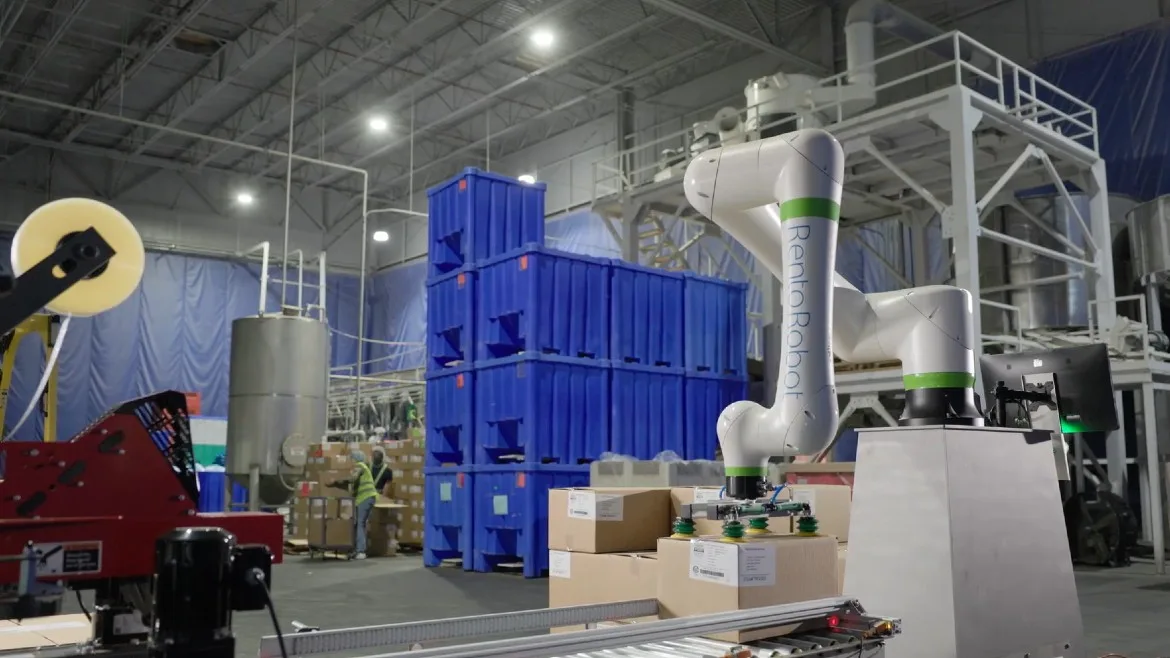
The implementation focused primarily on palletizing and pick-and-place functions, two applications commonly targeted by food manufacturers seeking to reduce repetitive manual handling. In Pearl Crop's case, production requirements varied across lines. Some operations required flexible automation that could be moved between work areas, while higher-volume applications demanded greater throughput.
The operational impact was felt quickly.
"The impact was immediate for us,” Turkhan says. “The biggest thing was eliminating any injuries, repetitive work for employees, and having the extreme flow and consistency.”
For food manufacturers, consistency is often just as important as speed. Automated systems do not experience fatigue, and they can maintain predictable performance throughout a shift. But workforce implications were equally significant for Pearl Crop. Rather than eliminating positions, the company used automation to redeploy workers into other roles.
That transition aligns with a broader trend throughout food manufacturing, where automation is increasingly used to address labor shortages while helping existing employees move into higher-value responsibilities.
Employee acceptance, often a concern during automation projects, proved largely positive. Pearl Crop says feedback from its employees was positive.
As labor availability remains a persistent concern across the food industry, processors are increasingly evaluating alternatives to conventional equipment acquisition models. Rental and try-before-you-buy approaches may offer a pathway for seasonal operations that need flexibility along with faster implementation.
For Pearl Crop, automation has become part of a broader growth strategy, with six robots rented and more coming. The gains in productivity also have allowed the processor to concentrate on future growth initiatives.
In an industry where seasonal peaks, labor shortages and capacity constraints increasingly intersect, Pearl Crop's experience highlights how flexible automation models may help food processors overcome barriers that have traditionally delayed adoption.
Looking for a reprint of this article?
From high-res PDFs to custom plaques, order your copy today!