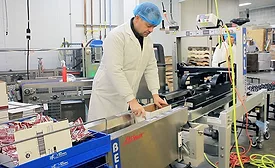
For the past almost 20 years, Pace Processing, a commercial bakery located in British Columbia, Canada has experienced consistent growth. That growth has led the company to adopt an automation strategy, but that presents its own challenges.
We have been monitoring the evolving situation around COVID-19/Coronavirus, which, as you know, is changing rapidly. The health and safety of everyone at the Food Automation & Manufacturing Conference and Expo is important to us, and we have decided that this event will be postponed and take place September 13-16, 2020 in Miami, Florida.
The Global Food Safety Initiative (GFSI), facilitated by The Consumer Goods Forum (CGF), has announced the results of its annual board election. The change in leadership structure marks a new era for GFSI, in keeping with recent developments in the organization’s governance and strategy.
Ever since the advent of legal cannabis product commercialization, companies developing and producing these infused foods and beverages have sought viable equipment to help them create consistent, high-quality products for recreational and medical cannabis consumers.
Blockchain technology allows retailers, suppliers and anyone who has access to the software, to have real-time information on a product’s origination and the stops it made along the way before it reaches its destination. However, when it comes to olive oil, blockchain can be useful in determining provenance and delivery path, but not the purity or freshness of the product.
Employee training is a cornerstone of an effective processing operation. But as processors struggle to find and keep qualified employees, it is also a benefit that can help keep employees happy and more willing to stay.
Consumers around the world are frustrated with plastic. A recent study from Global Data says that 35% of UK consumers are more likely to purchase products without any plastic at all, compared to goods even with recycled plastic.
We use experiments to understand how to make new or better products or processes. Experiments cost time and money. However, by using some simple statistical tools to design and analyze our experiments, we can minimize the costs while maximizing the useful information we gain.
 RSS
RSS