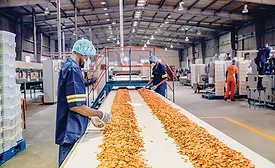
Food and beverage employees on the front line need
to remain safe and healthy to continue
to bring the food and beverage supply
to the masses during the COVID-19 pandemic.
When processors work with design-build firms to identify sites for and begin work on new construction projects, safety concerns traditionally involve factors such as ingress/egress, law enforcement and fire/EMS coverage and electrical and mechanical hazards.
But the ongoing coronavirus pandemic and potential disaster scenarios add another layer of complexity to the process.
While we can't pretend to cover in one article what an entire publication devoted to security does, we will look at some key pointers in keeping employees safer in the workplace.
Though relatively new, blockchain distributed ledger technology (DLT) applied in food and beverage can speed up tracebacks from days to seconds. One innovator—Pratik Soni, founder and CEO of Omnichain—is already taking blockchain technologies to the next level.
A new technology for sealed packages of fresh cut produce releases an anti-pathogenic agent inside the container to protect against bacteria, fungi and viruses.
The FDA has issued final guidance for industry entitled "Temporary Policy Regarding Preventive Controls and FSVP Food Supplier Verification Onsite Audit Requirements During the COVID-19 Public Health Emergency."
Given the ongoing issues with the COVID-19 virus and the reactions by government, which is treating the ongoing battle as if it was a war, the food industry is going to have to step forward.
The USDA has issued a proposed rule which would increase the assessment rate from $0.10 per 50-pound bag or equivalent of Walla Walla sweet onions handled to $0.15 per 50-pound bag or equivalent of Walla Walla sweet onions handled for the 2020 and subsequent fiscal periods.
 RSS
RSS