How Pre-Engineered Cobots Support Food Manufacturing
As food and beverage manufacturers face mounting pressure from rising costs, shifting consumer demand and persistent labor shortages, automation is no longer a luxury — it’s a necessity.
As FOOD ENGINEERING’s “The State of Food Manufacturing in 2025” survey revealed, 78% of respondents reported increased manufacturing costs in 2025, with labor and material costs per product rising by an average of 11% each. Yet despite these challenges, manufacturers are doubling down on investment: 54% expect their equipment, software and services budgets to grow this year, with 27% of annual budgets now allocated for use in equipment purchases.
In this climate, collaborative robots — or cobots — are gaining traction not just as an entry point to automation but as a strategic lever for resilience and growth. And among them, pre-engineered cobot systems are emerging as a fast path to impact.
Why Off-the-Shelf Cobots Are a Fit for Food and Beverage
The ingredients needed for an ideal food processing automation solution? Reliability, affordability, scale and ease of use. That’s what makes pre-engineered collaborative robot systems — which are ready-to-deploy, standardized solutions — perfectly designed to tackle common food processing and manufacturing tasks. Unlike traditional robotic cells, these systems require little to no programming, can be delivered within weeks and integrate seamlessly into existing operations.
One of the greatest benefits is their ability to flexibly fit into operations, with the ability to be relocated or reprogrammed for alternate tasks quickly and easily.
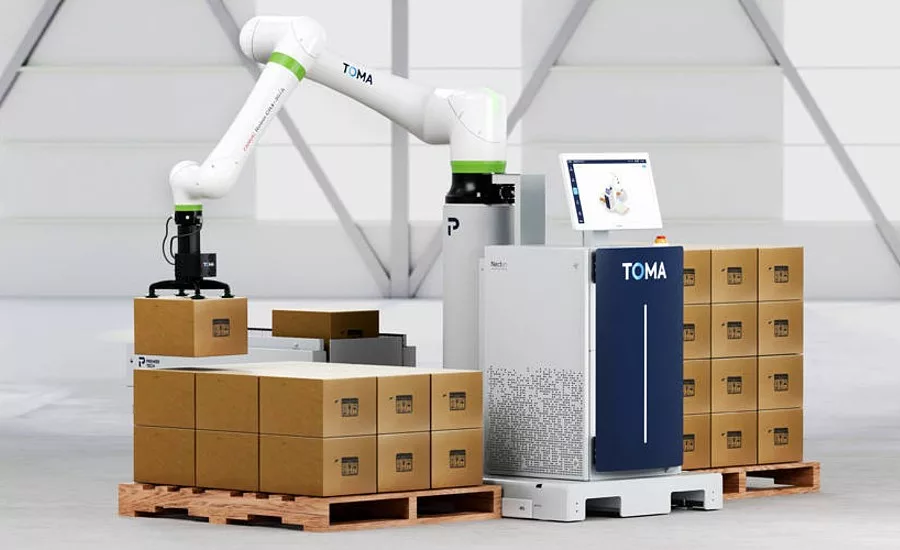
This is especially critical in end-of-line applications such as palletizing and depalletizing —tasks that are repetitive, physically demanding and increasingly difficult to staff. With compact footprints and expanded payload capacities, today’s cobots can handle heavier loads and fit into tight spaces without major layout changes.
Yet standardized cobot solutions address more than just palletizing — think inspection, dispensing, labeling, material handling and more — with new systems entering the marketplace weekly.
Cobots Keep Pace with Rising Throughput Demands
Despite economic headwinds, 60% of food manufacturing professionals expect throughput to increase in 2025 — by an average of 20% — looking again at the State of Food Manufacturing Study results. Many businesses cite new customers, expanded product offerings and improved efficiency as key drivers, which pre-engineered cobot solutions directly support by enabling flexible, scalable automation that’s adaptable to high-mix, low-volume environments.
Cobots equipped with vision systems can manage multiple stock-keeping units (SKUs), build custom pallet patterns and adapt to shifting product positions. In depalletizing, they excel at handling irregular stacks and orientations — tasks that traditionally required manual labor or complex automation. With drag-and-drop interfaces and hand guidance, operators can reconfigure cobot tasks in minutes, without coding.
And when facing the dilemma of production loss due to labor challenges, pre-engineered cobot solutions offer a practical alternative. Many come with built-in pathing, simulation tools and no-code programming, allowing manufacturers to deploy automation without specialized expertise.
This is especially valuable as 64% of manufacturers expect to contend with increased labor costs this year, in addition to shifting consumer demand. Cobots can help bridge that gap, allowing facilities to maintain output and quality even with lean staffing.
Cobots and New Food Safety
Food safety is another area where cobots can support operational goals. With Food Safety Modernization Act (FSMA) traceability requirements looming and recent recalls highlighting vulnerabilities, nearly half of manufacturers have conducted safety-related training in the past year. Cobots can assist by reducing human contact in critical zones, supporting allergen control protocols and integrating with traceability systems.
For the third of manufacturers that plan to invest in lab testing or analysis equipment, or the quarter that intend to purchase food safety management systems, cobots can complement broader digital transformation efforts.
5 Steps to Get Moving
It can be difficult to gauge the exact impact that current challenges in the food processing industry will present in the year ahead. However, one certainty is that automation will continue to grow as a cost-effective solution within manufacturing environments, and flexibility offered by those automation investments will allow for maximum impact, even when meeting changing demand.
Here are five considerations when evaluating whether a standardized automation investment may be a good fit.
- Define your goals: Focus on cost reduction, throughput gains or labor relief.
- Secure executive sponsorship: Leadership buy-in is essential for scaling.
- Build your team: Upskill internal talent or identify new roles.
- Partner wisely: Work with experienced integrators or robotics vendors.
- Compare offerings: Evaluate cycle times, user interfaces, functionality, inspection capabilities and ROI metrics.
If your operation is lean, budget-conscious or just beginning its automation journey, a pre-engineered cobot system could be the ideal starting point.
2026: The Year Automation moves from Optional to Essential
As packaging operations evolve, cobots will continue to redefine what’s possible on the factory floor. According to PMMI, the Association for Packing and Processing Technologies, cobot adoption in packaging automation is expected to double by 2027. With growing awareness of standardized systems and increasing investment in automation — even amid rising costs — now is the time to explore pre-engineered cobots not just as a gateway, but as a cornerstone of operational strategy.
Looking for a reprint of this article?
From high-res PDFs to custom plaques, order your copy today!