Company News
CJ Foods to Open Gim Cultivation Facility in South Korea
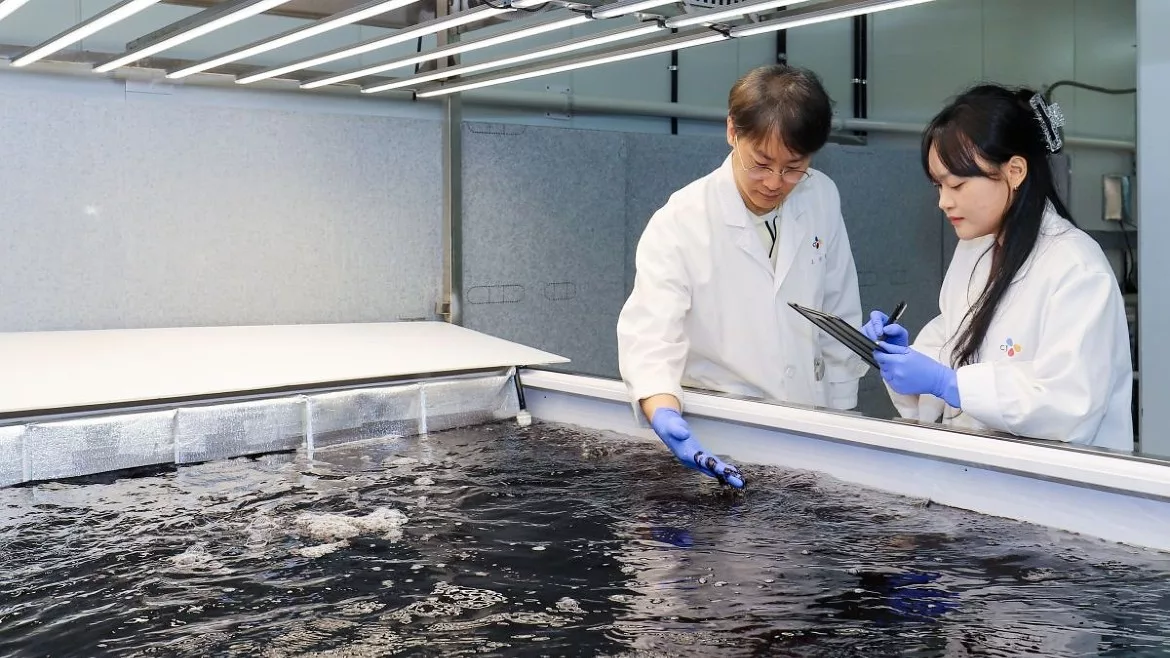
CJ Foods' land-based gim cultivation lab-pilot facility at CJ Blossom Park R&D Center.
CJ Foods will break ground in August on a commercial land-based gim cultivation facility in Cheonan, Chungcheongnam-do, South Korea.
Gim, a Korean seaweed food commonly roasted and eaten as a snack or used in dishes such as gimbap, has gained global attention as Korean cuisine continues to grow in popularity and consumers increasingly seek healthy foods. While global demand for gim is rising, conventional ocean-based cultivation is reaching its limits due to rising sea temperatures.
This milestone marks the company's entry into the commercialization phase, following its achievement as the first in Korea to successfully cultivate gim in a 3-ton laboratory-scale tank in 2021 and its securing of a gim variety optimized for land-based cultivation in 2022.
The Cheonan facility is scheduled for completion in the first half of 2027 and bibigo gim products produced there will be supplied to global markets including the U.S. Looking ahead, CJ also plans to build a shared-growth land-based cultivation model in partnership with local governments and fishing communities in South Korea.
The Cheonan facility will be equipped with multiple tanks and cultivation systems. Based on the lab-pilot facility at CJ Blossom Park R&D Center, the site will serve as a key bridge to mass production and help accelerate the growth of CJ Foods' gim business. At this facility, the company plans to move toward large-scale commercialization leveraging its core technologies, including life-cycle control technology, specialized culture media (nutrient solution), and integrated quality control.
Once operational, the facility will make it possible to supply gim year-round with fresh and consistent quality, rather than harvesting only during the winter season as in conventional ocean farming. Because the gim will be cultivated in a precisely controlled production environment, CJ Foods expects to secure differentiated taste and flavor as well as a high level of quality consistency. Through this initiative, the company aims to establish a stable global supply chain for gim and take a leading position in the sustainable future food market as worldwide demand continues to expand.
CJ has been building up technologies for land-based gim cultivation. The company developed its own gim variety optimized for land-based growing conditions and registered a patent for it in the first half of this year. Compared with conventional varieties used in ocean farming, this proprietary strain offers higher production efficiency and greater temperature adaptability. In addition, the company has developed technology to fully control the entire gim life cycle on land, from cultivation through quality management. This enables the stable, year-round harvesting of gim with quality that can exceed that of conventionally farmed, ocean-grown gim. CJ has also developed a specialized culture medium that promotes growth and maximizes taste and quality, improving production efficiency. The company has further secured technologies to prevent heavy metal accumulation, reduce waste and shorten production processes.
"This facility will serve as a testing ground for applying CJ's more than decade-long land-based gim cultivation technology at an industrial scale, while also becoming an outpost for the sustainable future of K-Food," says CJ Foods Global CTO Adam Ricciardone. "We plan to further accelerate commercialization so that consumers around the world can enjoy fresh, safe bibigo gim in every season."
Check out our 2026 Plant of the Year feature on CJ Foods' U.S. subsidiary, CJ Schwan's.
Looking for a reprint of this article?
From high-res PDFs to custom plaques, order your copy today!