Cell-Cultured/3D Printed
Is AI the Missing Link in the Commercialization of Cultivated Meat?

The cultivated meat industry is in a race against the clock.
After a surge of optimism and nearly a billion dollars of venture capital investment at its 2021 peak, funding for cultivated meat startups has declined precipitously. Industry coverage now swings between cautious optimism about long-term potential and deep skepticism about near-term viability.
While not inevitable, early failures and setbacks have marked the early stages of many breakthrough technologies. Overcoming them has often been key to eventual success.
Consider the example of electric vehicles (EV). Early EV models, such as General Motors’ EV1 failed commercially due to limited range, production costs and a lack of infrastructure. Yet innovation in battery chemistry, manufacturing scale and charging networks eventually changed the economics. Today, EVs represent nearly one in five new cars sold worldwide.
Cultivated meat is at a similar inflection point. Issues related to cost, scaleup and infrastructure do not signal the end of the industry, but they will need to be resolved for companies to remain viable.
This article addresses the challenges facing the cultivated meat sector today, particularly in scaling production. It also explores how AI — and in particular hybrid model digital twins — can help overcome critical hurdles to industry viability.
State of the Cultured Meat Industry: A Complicated Outlook
In addition to financial, regulatory and marketing challenges which are beyond the scope of this article, technical barriers at the scaleup stage are significant factors slowing commercialization.
First, delivering oxygen and nutrients evenly across large bioreactors is a major challenge. Stirring and aeration create shear forces that can damage delicate animal cells, which do not tolerate the stresses that microbial fermentation systems can endure.
EXPLORE MORE


Then there is the issue of oxygen transfer and nutrient distribution at scale. While 2-liter reactors can achieve high cell densities, scaling these processes to 10,000 liters or more introduces mixing and mass transfer problems.
Believer Meats was the only company worldwide to come close to implementing a perfusion system of this scale for animal cells, but unfortunately, it stopped operations due to a lack of continued investment.
A reliance on trial and error remains one of the biggest obstacles in scaling cultivated meat from lab success to industrial production. Without accurate predictive models, companies must manually experiment with nutrient levels, oxygen flow, temperature and other factors — one variable at a time. Each adjustment requires new pilot batches and extends development timelines, making the process slow and costly.
Because cell metabolism is complex and highly sensitive to small changes, identifying the right growth conditions without advanced modeling can take months or even years, and when considering differentiation aspects as well, this can become impossible for humans alone to handle. This traditional experimental approach consumes valuable bioreactor capacity, ties up resources and slows down the path to commercially viable processes. Without a way to reduce the number of costly physical trials, companies risk exhausting time and capital before achieving scalable and reliable production.
On the positive side, advances in AI and ML (including large language models (LLMs), generative AI, Bayesian optimization and Graph Neural Networks) are finding their way to the cultivated meat sector. And the potential to address key technical, cost and process challenges are significant.
Of course, not all applications of AI are shared with the public for competitive reasons, but there are increasing indications about its use. For example, ML models are being developed to optimize growth media — the most expensive input in cultivated meat production — by simulating fermentation conditions and improving ingredient yields.
AI tools are being applied to predict how feeding strategies and environmental conditions influence cell growth and fat accumulation, reducing the need for time-consuming physical experimentation. ML models help developers identify optimal nutrient combinations for cultivated fat production, accelerating the design of more efficient cultivation processes.
The challenge now is speed: Can AI-driven innovation scale fast enough to save cultivated meat from a capital crunch before it achieves commercial viability?
Hybrid-Model-Based Digital Twins: Rethinking Bioprocess Optimization
Building on advances in AI applications for media optimization and process modeling, digital twin strategies are starting to draw attention as a powerful tool for scaling cultivate meat production.
How does it work? A virtual model of the bioreactor system is created to simulate how changes in process conditions — such as nutrient concentrations, feed rates, cells age, temperature and oxygen levels — affect cell growth, metabolism and overall system performance. Already widely used in sectors like aerospace, energy and pharmaceuticals, digital twins help operators anticipate bottlenecks, optimize production parameters and reduce costly physical trial-and-error.
However, applying digital twins to cultivated meat introduces challenges not seen in traditional industrial applications. The digital twin concept was first formalized by NASA in the early 2000s as a way to simulate and monitor spacecraft systems using sensor data. In engineered environments like aerospace, system behaviors are highly predictable, governed by established physical laws and supported by large volumes of clean, structured data.
Evolving the Digital Twin: From Machinery to Biology
Unlike mechanical systems, cultivated meat production involves living biological systems where cell behavior is nonlinear, environmentally sensitive and difficult to predict. Small, fragmented datasets are the norm, and subtle environmental changes — such as slight shifts in oxygen levels or nutrient gradients — can impact growth outcomes. Cells cannot be optimized through deterministic equations alone, making traditional digital twin architectures insufficient for cultivated meat.
Why Cultivated Meat Requires a Hybrid Model Digital Twin
To address these challenges, hybrid model digital twins are being developed that combine mechanistic bioprocess modeling with AI techniques capable of learning from small, variable datasets. Mechanistic models describe the biological fundamentals: nutrient uptake, cell proliferation, metabolite production and stress responses. On top of this foundation, machine learning and AI layers calibrate to specific cell line and extrapolate patterns, optimize process parameters dynamically and predict outcomes under conditions that have not been physically tested. This hybrid approach moves beyond static monitoring to dynamic biological simulation — enabling virtual experiments that accelerate learning without exhausting physical bioreactor resources.
Small Data, Complex Systems: Optimizing Bioprocesses at Scale
Critically, creating effective hybrid model digital twins for cultivated meat requires integrating deep biological knowledge with advanced machine learning and AI. It is not enough to build a model — it must understand how living cells react to environmental stresses, resource availability and changing bioreactor dynamics over time. When designed correctly, these digital twins enable simulation-driven optimization of media formulations, feeding strategies, scaleup risks and process robustness — minimizing costly trial-and-error experimentation and significantly de-risking commercial scaleup.
By combining predictive bioprocess modeling with AI-powered learning from limited real-world data, hybrid model digital twins offer cultivated meat companies a strategic pathway to faster development, reduced costs and more reliable industrial production.
Key Differences: Traditional Digital Twins versus Bioprocess Digital Twins
|
|
Traditional Process Digital Twins |
Bioprocess Digital Twins |
|
System Type |
Mechanical systems (e.g., engines, turbines) |
Living biological systems (e.g., cultivated animal cells) |
|
Behavior |
Predictable, governed by physical laws |
Nonlinear, sensitive to small environmental changes |
|
Data Requirements |
Large, continuous datasets |
Limited and variable datasets |
|
Modeling Approach |
Physics-based and sensor-driven |
Hybrid of mechanistic biology models + machine learning and AI |
|
Goal |
Optimize performance, predict mechanical failure |
Simulate cell growth, optimize bioprocess parameters, minimize trial-and-error |
Use Case Example: Accelerating Cultivated Meat Scaleup with Digital Twins
A recent application of a hybrid model digital twin to a mammalian cell expansion process (essentially the early-stage growth of animal cells used as the starting material for cultivated meat) helps illustrate how this technology works in practice. The development team began with only a handful of small bioreactor runs. These runs provided basic information on how quickly the cells grew, how fast they consumed nutrients and how much metabolic “waste” they produced over time. In large reactors, these factors often become harder to control, which is one of the major reasons cultivated meat struggles to scale.
The digital twin combined two ingredients:
- A simplified model of how animal cells behave under different conditions
- Machine learning and AI tools that could learn patterns from the small amount of available data
With this, the model was calibrated so it could accurately reproduce the real growth behavior of the cell culture. Figure 1 shows an example: the simulated growth curve closely matched the actual measurements from a real reactor run. This gave developers enough confidence to use the model as a virtual test environment.
Figure 1
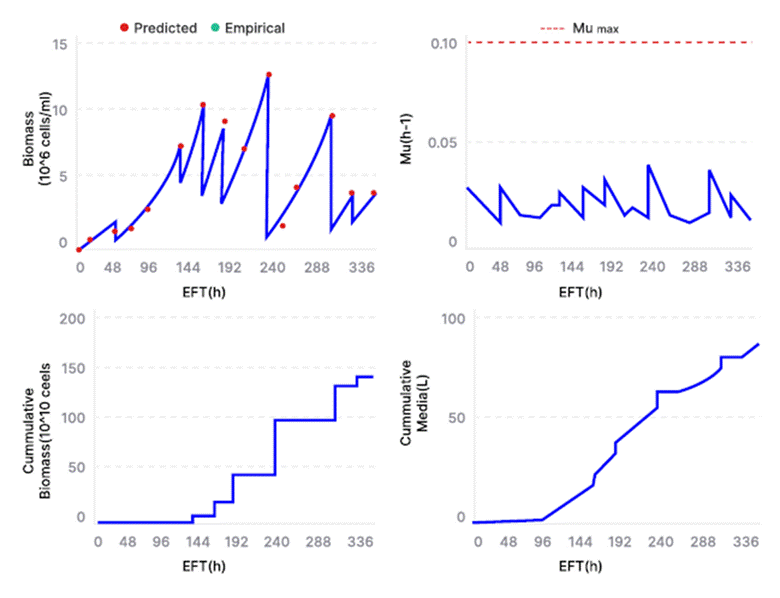
The simulation closely matches real measurements from a mammalian cell expansion run not used in training. This demonstrates that the digital twin can generalize and reliably predict process behavior under new conditions. Graphic courtesy of Algocell
Once validated, the digital twin was used to explore operating strategies that had never been tested physically — different feeding schedules, different media-refresh timings and different ways of keeping nutrients and waste products in safe ranges. Running these tests in software allowed the team to uncover which conditions supported faster growth and which ones caused cells to slow down or become stressed.
The result was a new operating strategy predicted to increase total biomass by more than twofold compared to the original approach. Importantly, this improvement came without running additional trial-and-error experiments in the lab.
For the cultivated-meat sector, this example highlights the practical value of hybrid model digital twins: they allow companies to learn more from the experiments they already have, reduce wasted bioreactor time and identify scaleup risks before moving into larger tanks.
In an industry where every experiment is expensive and capacity is limited, this kind of virtual acceleration can significantly shorten the path to commercially meaningful volumes.
Looking for a reprint of this article?
From high-res PDFs to custom plaques, order your copy today!