Case Study
How Automated Conveying Transformed Private-Label Pie Manufacturing
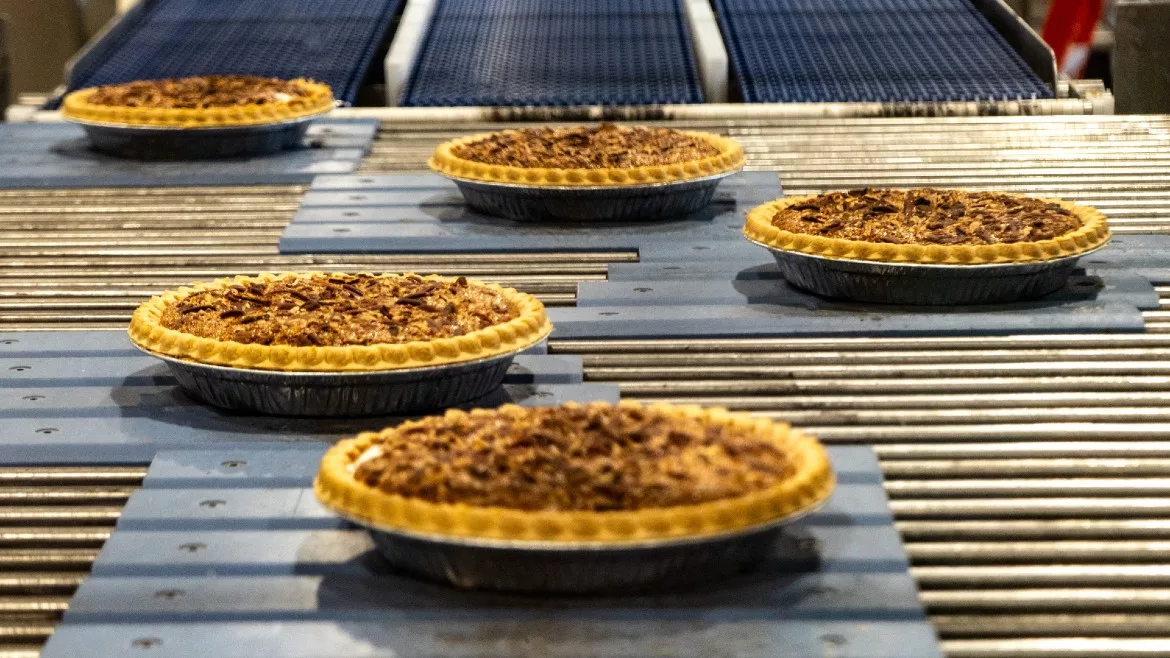
Gardner Pie Company’s new conveying line, designed and installed by Benchmark Automation, handles delicate pies from filling to baking, freezing an through end-of-line primary and secondary packaging.
Dark Chocolate Cherry, Pumpkin Spice Latte, Colonial Apple Red Raspberry, Sweet Potato Crunch, Strawberry Rhubarb, Butterscotch Cream, Peach Blueberry, Coconut Meringue, Caramel Apple Walnut, Broccoli Cheese and Pineapple Upside Down — these are but a few of the signature pies that Gardner Pie Company has been preparing for consumers over the past 80 years.
Gardner Pie is not only an icon in its hometown Akron, Ohio, the company’s reputation for pies is also felt throughout the United States where millions of its pies are sold each year through retail stores coast to coast.
Founded in 1945, the family-owned business, now in its third generation of ownership and management, continues to manufacture a range of high quality pies.
“Quality is our focus, not only on the flavor we put into our pies, but also the quality of ingredients that we use,” says Erin Goff, director of R&D, Gardner Pie Company. “This is what makes our pies so special. For example, we use fresh apples that have never been frozen. They are peeled, sliced and put into our pies within four days.”
“We work with peach orchards that keep peaches on the tree longer just for us, so they are riper, juicier, sweeter, and taste more like a peach,” Goff adds. “It costs us more to buy these peaches, but they taste better. We look for ingredients like this, and team up with growers and suppliers to acquire them for our pies. Our dough has always been one of the best things about our pies. We still make our dough in small batches so it is a very flaky, tender crust — just like our grandparents did 80 years ago.”
Adjusting to a Changing Market
Until recently, Gardner Pie’s business focused exclusively on manufacturing and selling frozen, unbaked private-label pies to retail stores. The retailers would bake the pies onsite in their own stores for sale to their customers. But this retail scenario has been undergoing a fundamental change.
“What we see happening in the retail industry is that talented labor is becoming an issue,” Goff says. “Fewer people know how to bake and finding people who are willing to learn is diminishing. When frozen unbaked pies go to grocery stores and store bakeries, they no longer have the talent or labor to bake the product properly. Retailers know this, so they are now more receptive to already-baked frozen pies that they can just thaw and put out for sale.
Gardner Pie’s management saw this shift in the market coming some years earlier, so started looking at automation to manufacture and package their pies as a baked and frozen product line, in addition to the company’s existing unbaked pie offerings.
Assessing Automation for a New Bake-and-Freeze Pie Line
Gardner Pie was interested in a series of conveying systems that would move pies from their ingredient filling station to their new oven, and then to a freezer and primary and secondary packaging.
“We were looking for a no-touch system,” Goff says. “One with smooth and even transfers, and equipment that could be gentle with the pies so we did not damage them through the process but also could keep up with the throughput that we wanted. We wanted to make sure the quality of our product going through this process did not change.”
“Some automation providers we talked with had trouble understanding that we needed a no-touch system because we did not want damage to our crusts or have the pie ingredients sloshing,” Goff adds. “We did not want the pies touching each other because of their tender, flaky crust being fragile, or being discolored from sloshing ingredients. More than one supplier suggested we change the recipe because that was the only way they could ensure the pies would not be marred or damaged.”
That all changed when Gardner Pie met with Benchmark Automation. Benchmark designs and manufactures product-handling systems for food and bakery manufacturers.
“We met with Erin and her team to understand what they were looking for and we were able to come up with solutions that worked for them,” says Michelle Pournelle, vice president and general manager with Benchmark Automation. “The gentle handling of the pies being the biggest challenge as we designed and tested throughout the process.”
“For Gardner Pie is it not just about moving product from A to B, it is about keeping the presentation of their pies pristine for their end customers,” Pournelle adds. “Our team spent a lot of time on the front end talking with Erin and her team about what they were needing before we even got into concepts or designing. Only then did we start utilizing some of our core technologies and modifying them to meet Gardner Pie’s needs.”
In October 2022, Gardner Pie selected Benchmark to design, build and install new conveying systems to connect the cooking, freezing and end-of-line processes. The systems were delivered nine months later, but with add-ons, the entire system went live in June 2024.
Engineering Gardner Pie’s Gentle Conveying of Pies
Moving pie-filled tins throughout filling, cooking, freezing and packaging lines involves sequential operations requiring precision and careful handling.
The line typically starts with empty tins entering the conveyor, then the tins are moved to filling stations for dough, ingredients and toppings, and onto induction into an oven for baking. The baked and hot pies are conveyed into a freezer, and when the desired temperature is reached, the pies are moved out for primary packaging, coding and labeling, then onto secondary packaging.
For conveying systems moving pie-filled tins between these processes, significant challenges must be overcome to maintain product integrity and cleanliness without impeding throughput.
“Benchmark Automation specifically designed Gardner Pie’s conveyor system for handling its fragile pies so as not to cause product marring, defects, spillage and splashing,” Pournelle says. “This meant providing adequate product control while on the conveyor systems. The conveyor design kept the pies from coming into contact with side rails, and it adequately adjusted to velocity changes around curves that would introduce unnecessary random product movement on the conveyor, minimizing the possibility of damage to the pies.”
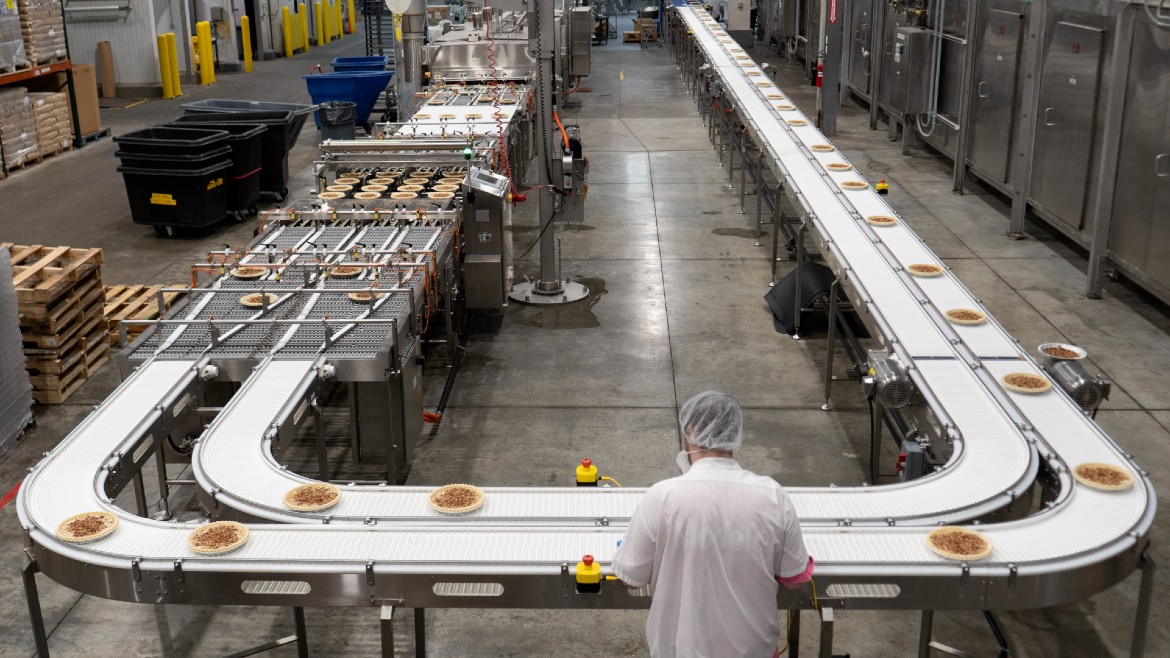
Gardner Pie’s conveyor flow from filling to oven. Image courtesy of Gardner Pie Company
The strategic use of product control devices brought a high level of positioning accuracy with more positive product handling throughout Gardner Pie’s 530 linear feet of conveyor systems.
Automated Infeed of Pies into the Oven
Benchmark Automation’s conveyor system design starts where ingredients are dispensed into dough-lined pie tins on a singulated line. The pies then go through a lane switch, which spreads them out four per row across, pre-staging the pies for entry into the oven for baking.
One of the challenges was to ensure that the pies do not touch each other. To achieve this Benchmark used a system of pin stops and indexing conveyors that allow the pies to be positioned by only touching the pie tins.
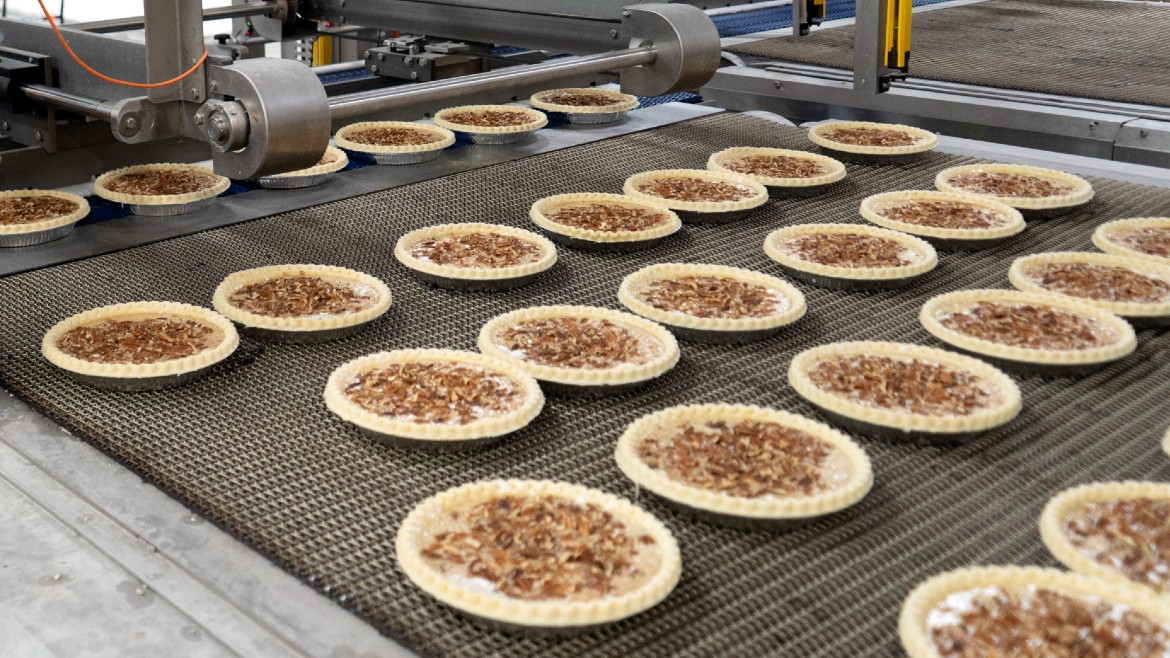
Automated infeed of pies into the oven. Image courtesy of Gardner Pie Company
“Employing a set of servo-motors, photo-eye sensors that detect the position of the pies throughout the system, metering conveyors, indexing conveyors and an overhead pusher system, the pies are then arranged into a nesting pattern consisting of a row of seven pies, then a row of six pies, and again a row of seven pies, to optimize space utilization in the oven,” Pournelle says. “Benchmark created a traffic-lane scenario where pies were backlogged while they were being transferred into the six-row or seven-row configurations. This nesting pattern of pies is then pushed into the oven. The overall size of the oven infeed conveying system exceeds 250 linear feet.”
Automated Removal of Pies from the Oven
After the pies are baked, each row of pies exits the oven. A row removal conveyor transfers the rows of pies to a perpendicular conveyor to produce a singulated line destined to entry into a freezer.
Servo-motors and mechanical diverts are used to create gaps between the pies as they are transferred 90 degrees to the singulation conveyor to ensure the pies do not touch. In singulation, the pies are transported to a spiral accumulation conveyor for a 30-minute dwell time to cool down before entering a freezer. From oven exit to entry into the spiral dwell, the conveyor system is more than 100 feet in length.
Automated Removal of Pies from the Freezer
Pie tins moving through a freezer lose their positioning, so there are frequently bottleneck points that can cause upstream and downstream throughput interruption. Most conveying systems that handle pies do not enable adequate lane dividing and combining to facilitate acceptable accumulation. Consequently, this was a key point of design focus for Benchmark engineers on Gardner Pie’s system.
“When the pies exit the freezer, Benchmark built an accumulation conveying system,” Pournelle says. “What this does for Gardner Pie’s throughput is if the downstream cartoner, for example, has a slowdown such as a box jam, the line upstream does not have to stop while the box is being cleared. This is important because upstream production of pies entering and exiting the oven, and baked pies entering and exiting the freezer, cannot be stopped. Pies coming out of the freezer must keep going somewhere.”
Three lanes of pies exit the freezer, which are singulated into one lane, then spread out into six accumulation lanes. Each lane has a dedicated servo-motor for spacing the pies so they do not touch. Servo-controlled guides provide efficient lane changing of incoming products, eliminating pies backlogging at the point of entry.
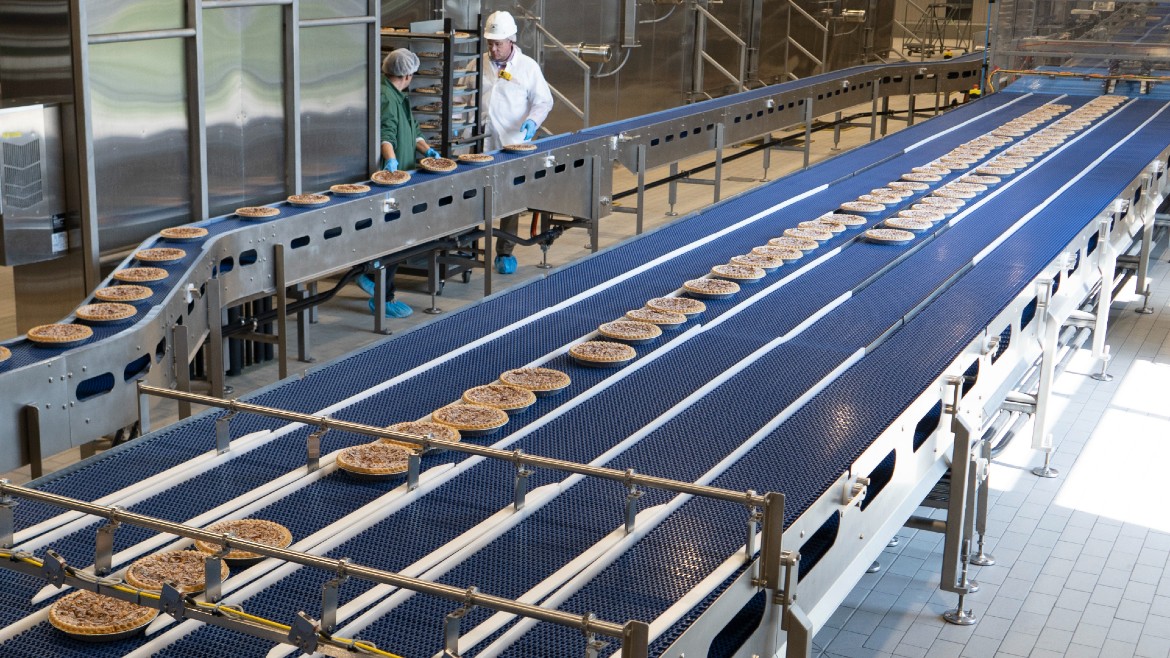
“The accumulation conveyors have the ability to modulate the speed of different sections of the conveyor via a centrally-controlled PLC and HMI,” Pournelle says. “The pies can be moving at variable speeds on different sections of the conveyor as dictated by throughput requirements. This controls the spacing of the pies on the conveyors, keeping them separated and equally spaced from each other to eliminate product contact.”
From accumulation, the line again singulates to feed downstream primary packaging into a box, which is sealed and labeled, then to an automated case packing station.
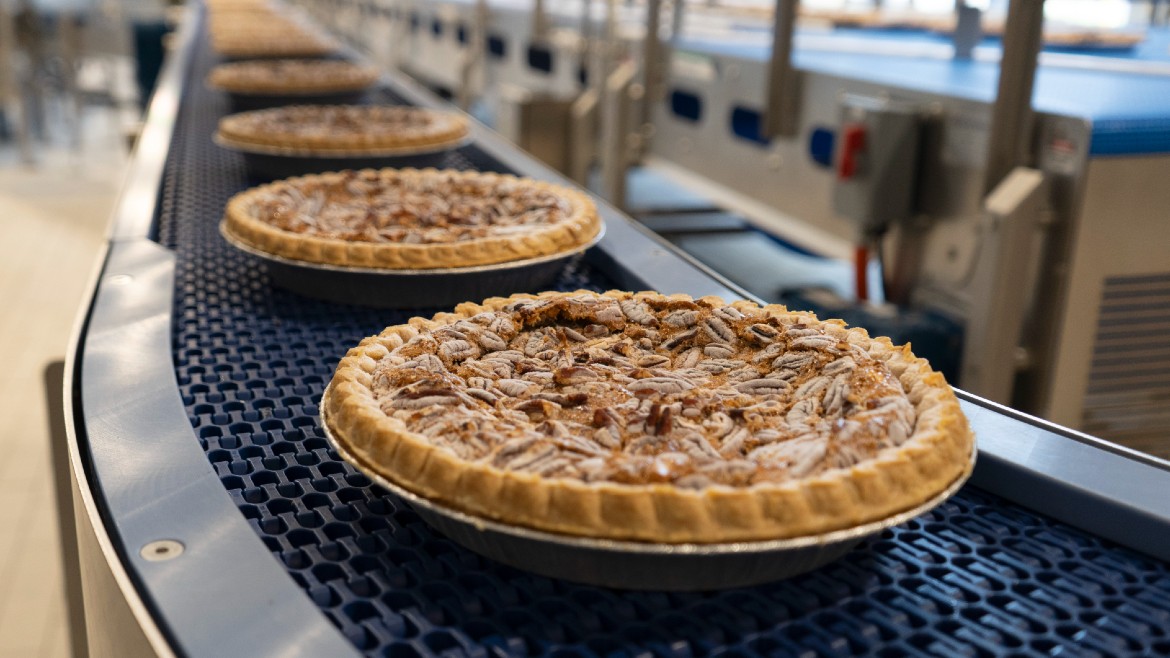
After accumulation, pies are singulated for primary packaging. Image courtesy Gardner Pie
Because Gardner Pie private labels its products, some of its customers have special packaging that requires hand packing. Benchmark designed the accumulation system to accommodate this requirement so that pies could be pulled off the line manually for primary and secondary packing by hand.
The length of the conveying system from freezer exit to secondary packaging exceeds 180 linear feet.
User-Friendly HMI
The HMI for the entire conveyor system was custom designed using common language and terms relating to Gardner Pie’s operations. Making changes in settings, such as pin stop timing, and conveyor belt speeds is easy to perform.
A useful aspect of the HMI is that it displays with pictures and exactly what and where any changes, calibrations or operational issues are located, so there is no need to go looking for them.
Cleanliness and Sanitation
Gardner Pie’s new conveyor line is designed to meet heavy wash-down criteria, where cleanliness and sanitation are a critical factor.
Heavy wash-down conveyors are used where it is anticipated that foods will come in direct contact with the conveyor in the normal process of product movement. The equipment is designed to endure heavy exposure to water applied with a high-pressure, high-volume hose, along with cleaning agents. The entire system, including the motor assembly and control electronics, are designed for thorough cleaning.
The conveyor design is free of crevices, ledges and dead spots, so that liquid – either from filling, condensation or during washdown – is completely drainable. Surfaces are designed to be convex, rounded or inclined to 45 degrees to promote the flow rate of product spillage and cleaning solutions. All tubing is closed-welded, and bolts, studs, mounting plates, brackets, junction boxes, name plates, end caps, sleeves and other items are continuously welded to the surface.
Constructed with rugged stainless-steel framing and guards and paint free surfaces, the conveyor system is ideal for the sanitary demands of pie manufacturing.
Gardner Pie’s Streamlined Conveying Systems
Pie manufacturers, like Gardner Pie, now have smarter conveyor systems specifically designed for gentle handling and the flexible needs of their filling, cooking, freezing and packaging lines.
These systems incorporate the necessary automation and product handling devices that enable more productivity, increased versatility, decreased product damage and realization of a more profitable bottom line.
“Benchmark worked closely with us and was able to build what we needed – a completely no-touch system,” Goff says. “The equipment is doing great. We have not had any issues. Prior to the new conveying automation, we were baking half a million pies per year. With the new automation we expect to increase our baked capacity to 8 million pies annually.”
Looking for a reprint of this article?
From high-res PDFs to custom plaques, order your copy today!