Traditional ERP: End of the Road?
AI promises a brand-new world of ERP systems, however, slapping AI onto a conventional ERP system that is already substandard won’t cut it.
While many food manufacturers rely on traditional ERP systems, AI has the potential to transform these solutions and support operational decisions, provided they make use of a “stable backbone” of operational data.
A recent McKinsey & Company article, "The end of ERP as we know it? Five ways AI is disrupting ERP," suggests that existing ERP providers will need to build AI agents into their systems and convince manufacturers — ERP users — that this technology can bring about real value and not be a costly experiment that wastes time and money. The move will also have to convince users that AI can successfully make informed decisions that a manufacturer’s experts have been able to do over the years, based on their experiences of what works and what doesn’t in planning and execution.
While traditional ERP vendors and system integrators understand conventional ERP systems and all the modules they comprise, they face potential competition from up-and-coming AI vendors that would like users to buy into novel AI-based ERP systems that use completely different architectures and can represent an unknown path forward with little proof of performance.
According to the McKinsey & Company article, while the extent of disruption is difficult to predict, it is clear that players in the ERP ecosystem need to reinvent their delivery models and solutions to stay relevant. ERP manufacturing users, for their part, should stay up-to-date, experiment with new AI capabilities and be open to questioning established ways of approaching ERP.
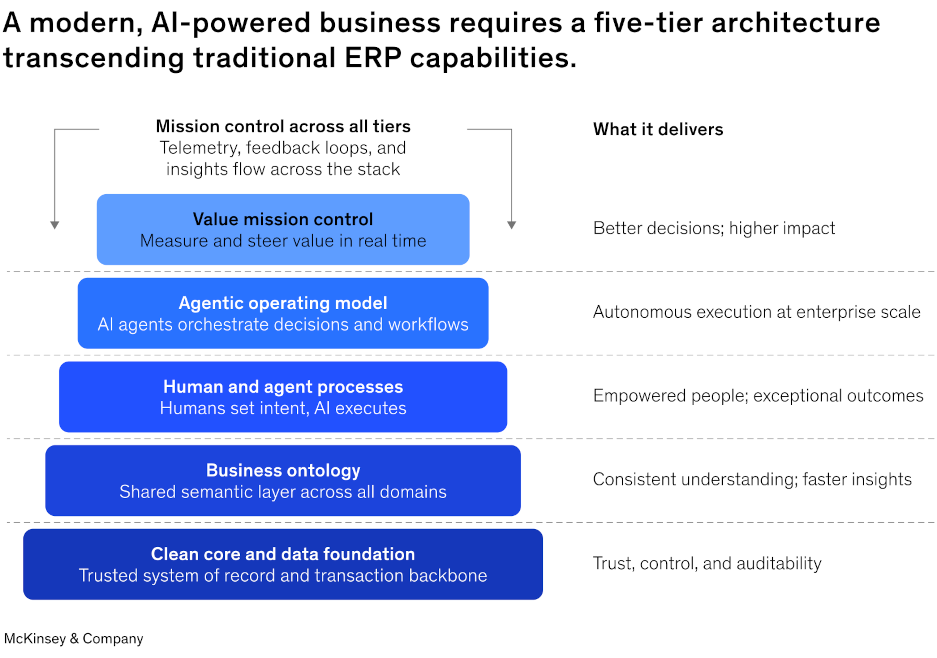
According to this image from McKinsey & Company’s article, new ERP architectures based on AI will become "headless." Users will no longer interact with ERP, but new AI-based application logic will still enforce business rules, data structures, systems of record for auditability. This new architecture is defined by value mission control, agentic operating model, human-empowering processes, enterprise-wide business ontology and clean core applications and data foundation. The core of ERP remains, and these will continue to be the core of ERP systems in the future. Graphic courtesy of McKinsey & Company (Click to enlarge image)
Current General Scope of ERP
In today’s fast-paced business environment, organizations are under constant pressure to improve efficiency, reduce costs, enhance customer experiences and make faster decisions, says Anant Mithsagar, CEO of RutamSoft, LLP, a supplier of control manufacturing software and partner member of the Control System Integrators Association (CSIA). While ERP systems have long served as the backbone of business operations, the emergence of AI is fundamentally transforming how these systems function and deliver value.
"Our focus is helping manufacturers apply AI in ways that improve operational performance," says Leanne Taylor, CEO, Syspro, an ERP supplier. "While much of the discussion around AI has centered on content generation and chatbots, we see significant opportunity in supporting the operational decisions that drive business outcomes. Those decisions happen inside ERP, where orders, inventory, production and financial processes come together.
"Over the next five years, ERP systems will play a larger role in helping organizations respond to change as it happens," Taylor adds. "They will continuously analyze signals across the business, helping teams anticipate disruptions, identify opportunities and coordinate actions across functions. As these capabilities mature, more routine decisions and processes will become automated, while people remain responsible for oversight and approval."
"At Wipfli, we consider the impact of AI on our partnered solution as highly variant, based on our focus on clients’ solutions and user base, as we are not a software publisher ourselves," says Dane Koepke, partner. Wipfli is a CSIA member. "AI has already shown that it is highly effective for our team in gaining a comprehensive understanding of a client’s vision on capability and their definition of success, mainly through AI meeting capture tools like Teams Copilot, which already seems legacy considering how fast AI is moving. Our current state of evolution in AI assimilation is now maturing past the use of individual productivity tools towards utilizing these advancements to prototype visual user experiences and addressing design gaps, even before we begin building our solutions."
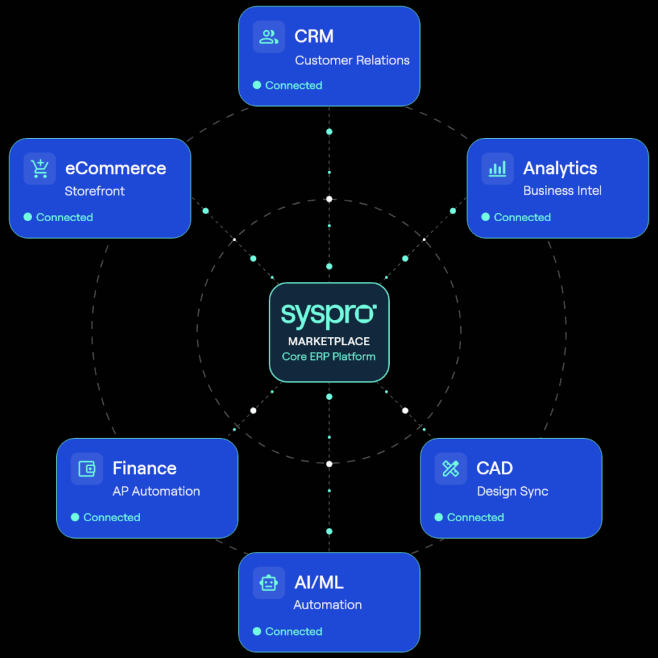
Syspro’s ERP platform allows users to integrate the modules they need for their specific business — from advanced analytics to CAD integration, CRM, AI-driven automation — and more, with solutions designed to work alongside Syspro. Image courtesy of Syspro (Click to enlarge image)
Moving forward, ERP publishers will continue to "agent-ize" their platforms so that they can be tailored to a particular client’s current requirements, while remaining flexible to keep pace with the changing nature of a business, both in process and their own users’ acceptance of AI, says Koepke. "However, ERP still contains fundamental best practices that are required to conduct commerce (e.g. a purchase order is still a purchase order) and trade as well as processes necessary to keep compliant with regulations and standards, such as GAAP or IFRS."
McKinsey’s Disruptions: 1. AI will evolve today’s ERP architecture
In the McKinsey article, the first disruption looks at two bifurcated possibilities for ERP evolution. First, ERP as it is currently known ceases to exist, and new AI agents will replicate all ERP functionality, with these systems provided by mostly new software companies. Second, a stable ERP backbone provided by existing and stable vendors is always required, and AI agents will execute ERP processes based on data from this backbone.
The first generation of ERP systems focused on centralizing business information and eliminating operational silos. These systems provided organizations with a single source of truth, improving visibility and process efficiency, says RutamSoft’s Mithsagar.
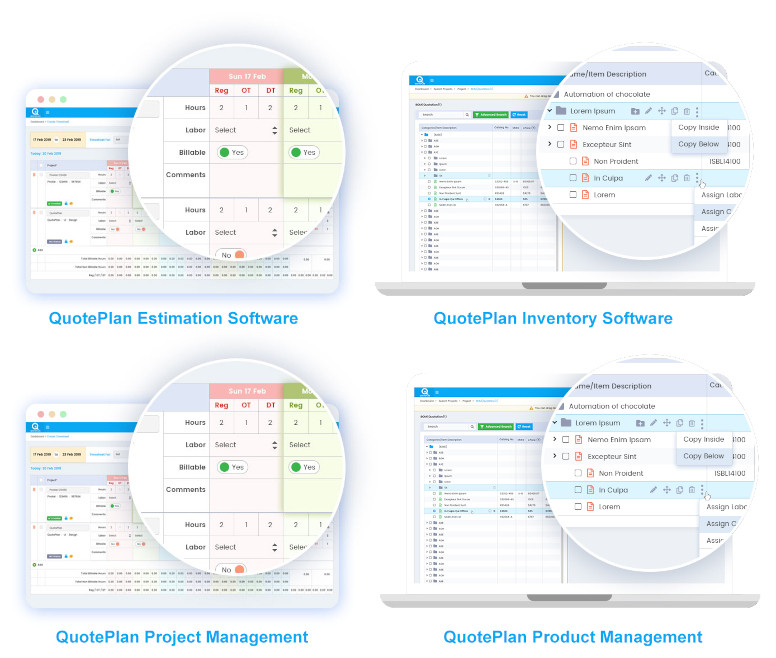
Rutamsoft is designed for system integrators building control systems and equipment for various industries and includes four main modules: QuotePlan Estimation, Inventory, Project Management and Product Management software. Image courtesy of Rutamsoft (Click to enlarge image)
However, merely gathering data is no longer sufficient as companies produce ever-increasing amounts of data. These days, organizations need tools that can comprehend data, spot trends and offer practical suggestions.
AI enables ERP systems to move beyond reporting and become intelligent advisors that help businesses anticipate challenges, uncover opportunities and make proactive decisions. Thus, instead of asking: "What happened?" businesses can now ask: "What is likely to happen next?" and "What action should we take?"
"McKinsey is right that the way people interact with ERP systems will continue to evolve," says Syspro’s Chris Lloyd, chief solutions and technology officer. Users will increasingly expect systems to surface relevant information, highlight exceptions and support decision-making in a more intuitive way. However, the role of ERP as the operational foundation of the business remains unchanged. Manufacturers still need reliable systems to manage inventory, production schedules, traceability, quality processes and financial controls.
"As organizations adopt AI capabilities, the quality of that foundation becomes even more important," Lloyd says. In industries such as food and beverage, gaps in data, processes or controls can have real operational consequences, from compliance issues to product recalls. Manufacturers will embrace AI where it consistently improves decision-making, reduces disruption and operates within clearly defined guardrails. Transparency, accountability and human oversight will remain essential."
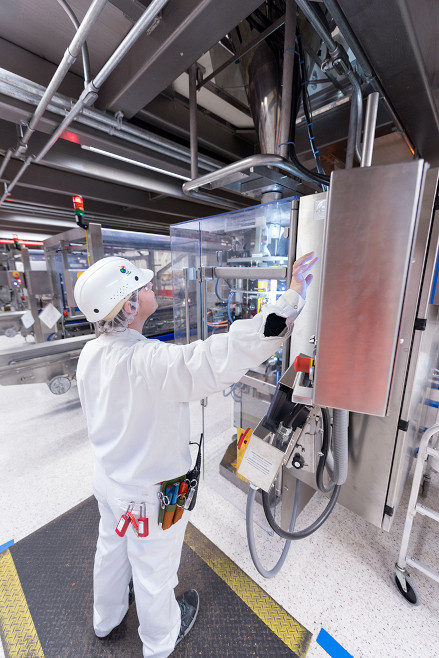
Operator checks in on the production planning system to see the day’s schedule, which is overseen by the facility’s ERP system. Image courtesy of Imagemakers Inc.
"We do not see AI replacing ERP wholesale in the near term, nor do we believe manufacturers should treat AI as a reason to rip out stable, mission-critical systems," says Chieng Moua, GVP and GM, product management, AI and innovation solutions, Rimini Street. "ERP still plays a vital role as the transactional backbone of the enterprise — preserving data integrity, enforcing controls, supporting compliance and maintaining the system of record manufacturers depend on to run production, procurement, finance, quality and supply chain operations."
"The ‘stable backbone’ framing actually undersells what a modern, connected manufacturing platform does," says Devin Burke, group product manager of Rockwell Automation. "ERP isn’t just a ledger that AI plugs into. In food and beverage manufacturing, the backbone includes production scheduling, quality management, traceability, supplier relationships and years of operational data that reflect hard-won knowledge about how your specific operation runs. That is not something you swap out or replicate quickly, and any AI that doesn’t have access to that full context is working with one hand tied behind its back."
The more useful question, Burke says, is what happens to the parts of ERP that have always been friction-heavy: manual data entry, rigid workflows, reporting that tells you what happened last week. Those are exactly the areas where embedded AI creates immediate, measurable value. Not by replacing ERP, but by making it far less painful to use and far more connected to what’s actually happening on the plant floor.
The bigger and more practical shift, says Rimini Street’s Moua, is that ERP will no longer need to be the primary place where users do their work. Agentic AI can increasingly operate above the ERP layer, acting as a system of action that executes, orchestrates and improves ERP-driven processes across applications and data sources. In this model, ERP continues to do what it does well while AI agents help reduce manual handoffs, bring to the surface exceptions, recommend actions, automate routine decisions and guide users through more adaptive workflows.
Burke adds: "Manufacturers don’t have time to consult a tool. They need intelligence that shows up in the workflow they’re already running, at the moment a decision needs to be made."
McKinsey’s Disruptions: 2. Companies will continue to invest in ERP modernization
The McKinsey article asks: Manufacturers will continue to invest in ERP modernization, but will AI agents become the new ERP front end? Can enterprises stay on a "good enough" legacy backbone and have agents build more-effective business processes and analytics on top of ERP?
Yes, Moua says. "Many enterprises can continue using a stable ERP backbone while deploying AI agents as a new engagement and process layer on top. We see momentum building around a headless ERP model, and we think this is one of the most practical paths for manufacturers that want modernization without the disruption of a large ERP replacement program. This approach fits the reality inside many manufacturing companies. Their ERP may not be modern by today’s user-experience standards, but it still runs the business."
This disruption is probable for those manufacturers that have already modernized their ERP solutions over the last 10 years, says Wipfli’s Koepke. "However, Wipfli continues to regularly advise manufacturers on ERP conversions with no notable decline in conversations over the past few years. While you can address analytics with AI on legacy applications because data can be more easily consumed into these models, confronting the desire for more effective and tailored business process capabilities must first be built upon modern ERP cloud solutions before AI can really impose its impact for the end user experience."
"Agents will increasingly become the front end — how people experience ERP — so you ask in plain language and the system answers and acts," says Syspro’s Taylor. "But the interface was never the hard part, and a smarter front end can’t rescue a weak backbone. Businesses may be able to extend the life of some legacy systems, but they will still need trust in the operational foundation that supports production, inventory, quality, compliance and customer commitments. That’s particularly important in industries like manufacturing where operational decisions have immediate financial and customer impact. Get that foundation right, though, and AI can turn trusted operational data into reliable action, and that’s where the real value sits."
According to RutamSoft’s Mithsagar, AI-driven ERP provides many benefits including faster process execution, reduced operational costs, improved accuracy, fewer manual errors and increased productivity. Businesses can leverage predictive capabilities to forecast product demand, predict inventory shortages, anticipate equipment failures, optimize procurement planning, improve cash flow forecasting and reduce supply chain disruptions.
McKinsey’s Disruptions: 3. ERP transformations will be two times faster and cheaper
The third disruption the McKinsey article suggests is that ERP transformations will be two times faster and cheaper. In one case, manufacturers will use ERP migration as a catalyst for business transformation, and in another case, they will take a migration path if ERP vendors offer it, accepting a more modest initial modernization at the cost of less business value.
One of the unplanned benefits for the slower acceptance of ERP cloud transformation in the manufacturing sector is that those lagging companies may now have a better business case for ERP investment because of the ROI with artificial intelligence that now exists, Koepke says. "Where each manufacturer’s business case may reflect either of the two versions that McKinsey puts forth in the article, it is not a reach to conclude that AI will add fuel to those who have been lagging in ERP modernization."
"We see manufacturers becoming much more selective about ERP transformation," Moua says. "Some will still use a migration as a broader business transformation catalyst, especially when the business case is strong and the organization is ready for that level of change."
"AI can take real effort out of process discovery, redesigning, documentation and migration planning," says Syspro’s CFO Mathias Høyer. "That makes parts of modernization faster, and that’s worth having. But faster and cheaper are the wrong scorecard. I’ve seen projects come in on time and under budget and still fail to move the business. What I care about is whether modernization shows up in business outcomes and ultimately the P&L, in visibility, operational control and performance we can measure. This should be treated as a business decision first and a technology project second. Get that order wrong, and the speed savings won’t matter."
McKinsey’s Disruptions: 4. ERP vendors could regain control of the ERP ecosystem
The fourth disruption McKinsey suggests is that ERP vendors could regain control of the ERP ecosystem as ERP users will expect efficiencies to be passed on to them. Emerging AI-native startups, however, are offering AI-enhanced ERP delivery capabilities matching as-is with to-be process models, reading custom code and mapping it to the new ERP standard. But what experience do these start-ups have with the complexity of ERP software, especially as used in the food and beverage industry? Wouldn’t ERP systems have a lot of historical data, which could be used to build agents integrated with the ERP data?
"ERP may likely gain control of the ERP ecosystem as disparate systems and process can now consolidate into one application solution," says Wipfli’s Koepke. "The birth of AI could finally push [laggard] manufacturers off the sideline and into ERP transformation because of the anticipated ROI from AI. However, a potential opportunity exists that will allow ERP vendors and advisors to remain close to their clients, well beyond the initial deployment of a new ERP solution. Essentially, revenue and services can continue to grow, albeit at lower amount, over an extended period of time as manufacturers continue to ‘tweak’ their solutions, driven by their user base’s acceptance, and perhaps desire, for AI assistance in their operational activities.
"While these startups have shown impact, they are currently transforming the ERP landscape at the lower end of operational complexity, mainly around finance and accounting. Ironically, finance and accounting tend to be where ERP capabilities are most aligned around best practices that I mentioned earlier," Koepke says. "In my review, most of the new entrants are building analytics using generative AI to differentiate their solutions, rather than addressing complex operational processes, like those that exist in manufacturers, and are already proven in leading ERP solutions."
McKinsey’s article suggests that long-standing ERP vendors with AI support can now regain control over delivery quality of startups. "The framing of regaining control assumes established platforms lost it, and we’d push back on that," says Rockwell’s Burke. "What’s actually happening is that the value of proven, deeply integrated platforms is becoming more obvious as manufacturers get serious about AI delivering real operational results rather than demos."
"Startups bring fresh ideas, and that’s healthy," says Syspro’s Lloyd. "But food and beverage manufacturing isn’t a greenfield. Every day it’s lot traceability, quality management, shelf-life, supplier performance, production constraints and regulatory compliance. That complexity isn’t a problem to code around. It’s the context that makes AI useful. ERP holds decades of operational history showing how a business actually runs, and no horizontal AI tool can pick that up in a release cycle. The opportunity isn’t AI replacing that knowledge. It’s industrial-grade AI learning from it, so people apply it faster and more consistently."
McKinsey’s Disruptions: 5. The value creation approach in ERP will shift from build to buy
McKinsey suggests that the value creation approach in ERP will shift from build to buy. It’s up to the ERP vendors and their solution partners to drastically increase the speed of bringing comprehensive embedded AI solutions to market. There are several prerequisites for doing this successfully: Take a clean-sheet approach; make P&L impact clearly measurable; fully embed AI solutions; ensure the commercial model for AI capabilities is simple; ensure agents in the ERP can communicate with agents outside the vendor-specific ERP ecosystem…etc.
"Manufacturers are focused on business outcomes, not additional technology projects, so the shift from building capabilities internally to adopting proven solutions makes sense," says Syspro’s Taylor. Most organizations are not looking to develop AI tools from scratch. They want solutions that improve schedule adherence, reduce order exceptions, better align inventory with demand and help teams make faster, more informed decisions."
"For these initiatives to succeed, the value needs to be measurable and connected to operational and financial performance," Taylor adds. AI also needs to be integrated into the processes where work happens and work across the broader technology environment a business already relies on. The right approach will vary by organization. Some manufacturers may benefit from capabilities embedded directly within existing workflows, while others may prefer a more modular approach. The priority should be delivering practical business value while maintaining appropriate oversight of critical decisions."
"Since we are about 15 years into the push for ERP cloud transformation, many ERP publishers may sense that we are on the downslope of conversion," Koepke says. This will create urgency to attract those remaining manufacturers to not only their ERP solution but [also] to their surrounding ecosystem of tools and other products. This became evident a few years ago when most ERP publishers moved to multi-year contracting on licensing, which was intended to reduce customer attrition and the need to invest in retaining customers.
This upcoming acceleration of effort by these ERP publishers may converge with the other force that we are now seeing, where companies are back to building "best of breed" solutions, where they are not tethered to one solution or ecosystem, Koepke adds. These companies tend to also have made more internal investment in both technology and IT employees, who can "build" upon an initial investment versus relying on a publisher to create innovative products for purchase around AI and other automation.
While it hard to predict which effort will win out with manufacturers, competition for investment dollars will increase, giving companies more choice around their investment in business applications, whether it is for the surrounding ecosystem or the enablement of artificial intelligence to allow companies build the solution personally for them.
Resources:
"The end of ERP as we know it? Five ways AI is disrupting ERP," May 11, 2026, McKinsey & Company
"The Rise of Agentic AI ERP," White Paper, Rimini Street
Looking for a reprint of this article?
From high-res PDFs to custom plaques, order your copy today!