Food Safety
Food Safety Today: Ignoring Past Mistakes Spells Trouble for the Future
We have modern diagnostic tools, track-and-trace systems and practiced recall protocols, but when everything seems to be going well, we ignore what history has taught us and let our guard down.
Need to Know
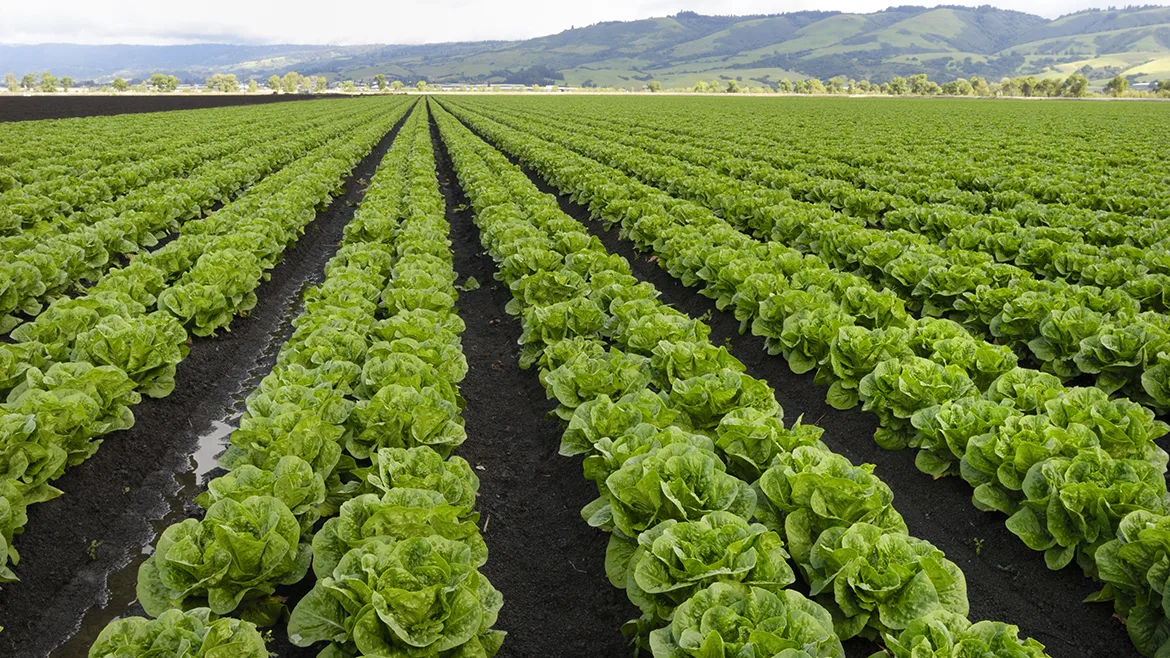
- 2026’s major Cyclospora outbreak was connected to shredded lettuce from Taylor Farms de Mexico.
- Taylor Farms has previously been connected to Cyclospora, E. coli and Salmonella outbreaks.
- Better data management across the supply chain, especially ahead of the FSMA 204 compliance deadline, can speed up and tighten recalls.
In September, the CDC declared the Cyclospora outbreak over. In the aftermath, two people died and thousands were sickened, causing hospital stays and loss of family income and productivity in the workforce.
But due to the challenge of getting accurate and timely test results that could pin down the product source and its grower/producer in a reasonable length of time — and with a cautious public — other growers needlessly discarded their perfectly good produce, taking a major hit and affecting the local economy where temporary farm labor was no longer needed.
Finally, Taylor Farms de Mexico began a major iceberg lettuce recall on July 17 after testing showed that its products were infected with Cyclospora, a parasitic illness, only known to be transmitted by human feces where proper sanitation isn’t followed. Of the samples collected during the onsite inspections in Mexico, two samples tested positive for Cyclospora. One positive sample was from a tank that held outgoing wastewater from the Taylor Farms de Mexico processing facility. The second positive sample was collected from a drainage ditch of an iceberg lettuce grower identified in the FDA’s traceback investigation.
Infected groundwater can be transmitted to crops through primarily aerial irrigation, but also other forms of irrigation where the plants are susceptible to infected groundwater.
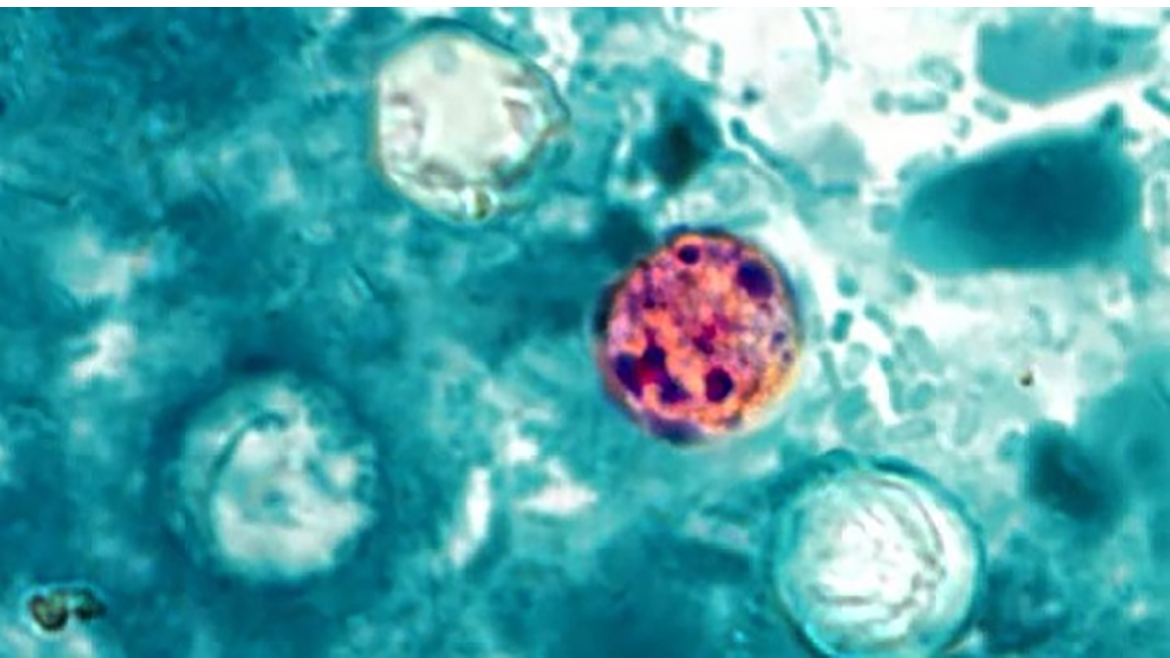
Cyclospora cayetanensis is a unicellular parasite that causes an intestinal infection called cyclosporiasis. Because Cyclospora is a coccidian parasite, infected people shed oocysts (rather than cysts or ova) in their stool. Cyclosporiasis spreads when people ingest food or water contaminated with the parasite. Image courtesy of CDC
The industry needs to use its rear-view mirror to learn from past mistakes — as George Santayana said, “Those who cannot remember the past are condemned to repeat it.” This 2026 Cyclospora recall is not a new occurrence for Taylor Farms’ Mexico operation. In 2013, a bagged salad mix sourced from five different ranches, processed and distributed by Taylor Farms, sickened 143 people in Iowa and 78 in Nebraska with Cyclospora. Over the years Taylor Farms has also shipped various produce products with E. coli and Salmonella contaminations.
EXPLORE MORE


It’s unknown when the last time Taylor Farms USA food safety experts visited its Mexico operation, looked for potential contamination problems and tested products for infection, but according to a PBS report, FDA visited the site in mid-August, a month after the official recall was announced. The last time FDA had visited the Mexico site was 2019, before the COVID-19 pandemic. Though not required to visit foreign suppliers routinely, the FDA will fast-track a site that has had a recall; rather, it is the importer who must establish a schedule to verify its suppliers — which includes performing or reviewing on-site safety audits at least once every three years for any food involving significant hazards controlled by the supplier.
Under the FSMA FSVP regulations, importers must identify and evaluate known or reasonably foreseeable hazards for each food imported (e.g., biological, chemical or physical hazards). Importers must conduct and document verification procedures — such as periodic on-site audits, lot sampling and testing, or reviewing food safety records — to ensure standards match U.S. preventive controls. In addition, importers are required to maintain written FSVP records for each food and supplier. During an inspection, records must be provided in English or translated promptly upon request. Records must be accessible onsite or retrievable within 24 hours.
Changes to Food Safety Reporting and FSMA 204 Timeline
Not all blame can be put on Taylor Farms, according to Bill Marler, noted food safety attorney. As he suggested in his Aug. 19 newsletter, CDC cutbacks in monitoring rules and delays in implementing FSMA 204 guidelines have caused the industry to be caught seemingly off-guard. In addition, while emphasis has been put on groundwater, the rules didn’t specifically include Cyclospora.
Historically, the Foodborne Diseases Active Surveillance Network (FoodNet) has conducted surveillance for Campylobacter, Cyclospora, Listeria, Salmonella, Shiga toxin-producing E. coli (STEC), Shigella, Vibrio and Yersinia infections diagnosed by laboratory testing of samples from patients. FoodNet also conducted surveillance for Cryptosporidium through 2017.
However, FoodNet stated that reporting for data collected on or after July 1, 2025, is optional for all pathogens except Salmonella and STEC. According to CDC, narrowing FoodNet’s reporting requirements is, in part, because the surveillance landscape has changed since the collaboration began in 1995. Today, other surveillance systems monitor for infection with FoodNet pathogens. Changes to the reporting requirements and associated activities allow FoodNet staff to prioritize core activities, while maintaining both the infrastructure and quality FoodNet represents.
Delay of Implementing FSMA 204
In March 2025, FDA announced its intention to extend the compliance date for the Food Traceability Rule by 30 months. According to FDA, the compliance date extension does not amend, nor does the FDA intend to amend, the requirements of the final rule. Instead, the compliance date extension affords covered entities additional time to ensure complete coordination across the supply chain to fully implement the final rule’s requirements — ultimately providing FDA and consumers with greater transparency and food safety.
Marler suggested this date extension issue is a Congressional funding problem. “Strike the funding prohibition. The rule exists and is law; Congress has simply forbidden the agency to spend a dollar enforcing it until the summer of 2028.”
According to Marler, California growers were affected by the loss of consumer confidence in lettuce, and hence, after the spinach debacle in 2007, the Leafy Greens Marketing Agreement (LGMA) was formed by several growers/producers. LGMA wrote traceback and recall protocols into a voluntary agreement in 2007, though not much has been heard from LGMA since. Marler’s point is that had California growers abided by their own advice, they should have been able to distinguish their lettuce from the contaminated Mexican product.
Environmental Water as a Transmission Medium for Cyclospora
According to the Water Environment Federation (WEF), “concerns about cyclosporiasis and the absence of a direct source have raised questions for the water sector.” Members of the WEF’s Disinfection and Public Health Community have responded to these questions with a fact sheet tailored to the needs of water professionals. As detailed in the fact sheet, cyclosporiasis is caused by the parasite Cyclospora cayetanensis, and outbreaks are generally foodborne and believed to be caused by contaminated irrigation water or wash water used in the production of produce that is eaten raw.
Methods of eliminating Cyclospora from contaminated water include:
- Absolute 1-micron (or finer) filtration as Cyclospora oocysts measure roughly 8 to 10 microns
- Ultraviolet (UV) irradiation at high levels
- Ozonation: Ozone gas damages the tough outer membrane of oocysts where chlorine fails
- Heat (temperature in excess of 160°F; not practical for large water volumes)
Marler advises that growers, shippers and buyers need to treat agricultural water against the right organism. LGMA specifies treatment of surface water for overhead irrigation within 21 days of harvest. The problem is, if the treatment is designed around potential E. coli contamination, chlorine is an adequate solution, but it’s not effective against Cyclospora.
On Taylor Farms’ Cyclospora webpage (at the time of writing this article), the diagram, “Food Safety at Every Step,” in the “Irrigation Water (#2)” box reads: “Open-source water from irrigation canals or reservoirs is treated with chlorine (Cl2) prior to use post germination.” Problem is as stated above; chlorine is ineffective in killing Cyclospora.
According to Marler, FDA suggested in the Taylor Farms 2013 Cyclospora outbreak that if Cyclospora is a reasonably likely hazard, then evaluate the wash step. But, according to Marler, nobody was ever assigned the task.
While it’s good to know there are treatments for contaminated groundwater, the better question to ask is how did the groundwater become polluted in the first place? Then deal with corrective steps to clean the environmental conditions that contaminated the groundwater.
In 2021, FDA provided in a letter good advice to the Florida Fruit & Vegetable Association after a multistate outbreak of Cyclospora infection linked to a bagged salad:
“…However, the presence of Cyclospora cayetanensis in a water management canal that had previously supplied water to produce farms in the region, and specifically to a farm identified in the traceback, suggests the need for a collaborative effort by state, federal and industry partners to better define the scope and sources of contamination and identify appropriate risk mitigation measures… FDA urges produce growers in the St. Lucie produce growing region that use water from the water management canals to consider Cyclospora cayetanensis when assessing the risks associated with their operations and take risk mitigation measures, where appropriate…”
In the FDA document, one of the key points in a “call to action” read: “When Cyclospora cayetanensis is identified through microbiological surveys, consider preharvest or post-harvest testing of the product or the environment, implement root cause analysis, working with relevant partners, to determine the potential source(s) and route(s) of contamination and then implement appropriate prevention and verification.
Microbiological Testing a Challenge
Taylor Farms’ Cyclospora webpage says it invests more than $200 million annually in food safety: “In addition to comprehensive daily controls like monitoring, training, and testing, this investment also includes longer-term commitments such as food safety research — through our own internal research team and collaboration with recognized food safety research leaders from around the world — new technology development, and capital investment in wash systems, processing line, and facility enhancements, specifically around sanitary design and environmental control. Taylor Farms-developed testing methodologies are now standard practice across the fresh produce industry. We’re using the latest FDA-validated testing method for Cyclospora and are continuously evaluating new detection innovations.”
Even so, considering the challenge of isolating and testing for Cyclospora, it’s possible that Taylor Farms could have just missed a positive result.
Over the last decade, the microbiological tools for testing the presence of Cyclospora have improved significantly, and FDA has developed a real-time PCR method for the detection of Cyclospora, allowing for the rapid detection of the parasite in food and agricultural water matrices by targeting the C. cayetanensis 18S rRNA gene. While there were some complications, extended genomic datasets have made testing more conclusive. [1]
However, there’s still the challenge of isolating the oocysts in water and food matrices as there often isn’t a high level of concentration in samples.
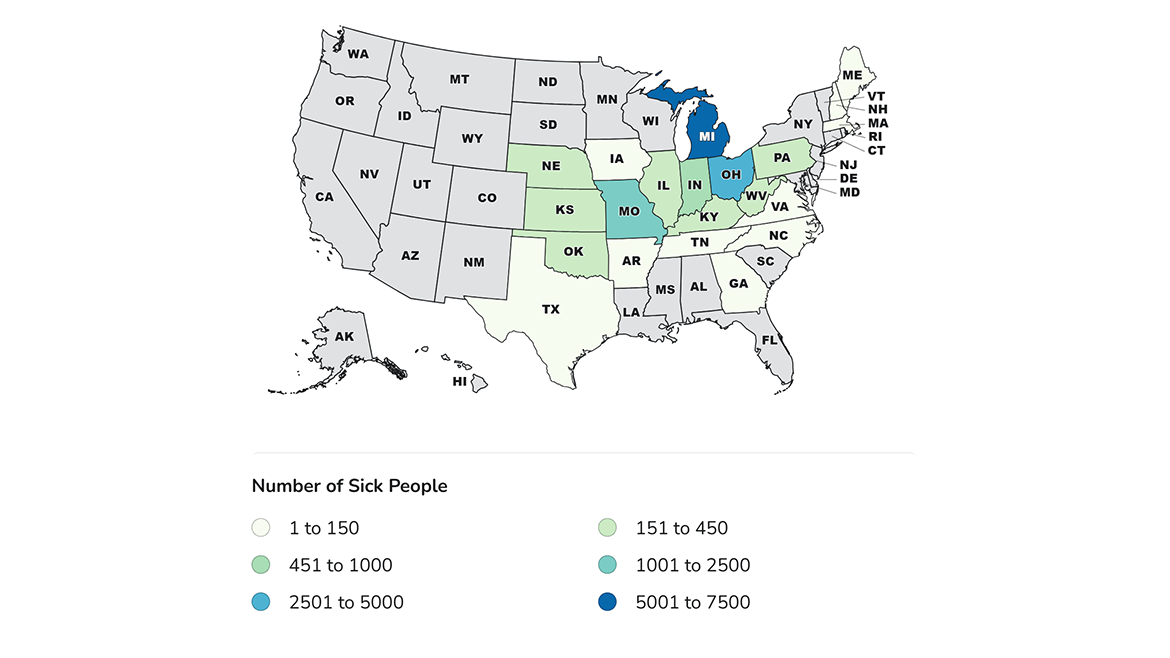
(Click on the image to enlarge.) The Cyclospora case count in the 2026 summer-fall iceberg lettuce contamination, as provided by the CDC, was the highest in Michigan. Total illnesses reached 12,883 with 570 hospitalizations and two deaths. Image courtesy of CDC
Tools for Managing Recalls to get Faster Results
While there were issues in microbiological testing and getting enough information to connect the dots between testing infected persons and verifying the source, there’s also no doubt that a number of parties mishandled the Cyclospora recall. Several media sources commented on the issues for more than a month, with some more accurate than others. Besides more rapid detection, better methods for handling recalls are important to help supply chain partners and the fearful public separate fact from fiction, to understand that not all — in this case — iceberg lettuce was infected.
“Kill the fear with specifics,” says Frank Kenney, GTM strategy & enablement at Cleo. “Consumers walk away from all lettuce when nobody can tell them which lettuce. The cure is precision. If you can name the lots, the dates, the facility and the stores within hours, retailers keep the clean product on the shelf and the public hears ‘this farm, this week’ instead of ‘lettuce.’ Uncertainty spreads fast. Specifics stop it.”
Then, close in by connecting the dots, Kenney adds. “Finding the lot number is step one. Following it is the real work. Trace it one step back to the field and the packing line. Trace it one step forward through every warehouse, every truck and every store it touched. That only works if the data from all those partners is connected and readable in one place. Otherwise, you’re blowing up an entire category because you couldn’t find one pallet.”
Finally, Kenney says, “Get it off the market and prove it. Knowing where it is doesn’t pull it off a shelf. Somebody has to send the stop-ship order to the carrier, the hold to the warehouse and the pull notice to the store, then confirm each one actually happened. That’s where the economics show up, too. Return it, wash it or dump it, and who gets the credit? When the instructions and confirmations run through the same connections your partners already use to trade every day, the recall moves as fast as the product did.”
“Visibility tells you there’s a problem,” Kenney adds. “Orchestration is how you fix it. Where is it? What will it cost? How do you talk about it? Get those three right and you have a recall. Get them wrong and you have a crisis.”
The tools are available to take all the steps Kenney describes. Automated recall management tools make it possible to pass recall details from supplier to distributor to point of sale – and even into the hands of consumers – in a way that’s consistent, customizable and actionable, says Roger Hancock, Recall InfoLink CEO. Effects of a poorly handled recall, like consumer fear, inflated scope or product staying on the shelf, often have similar underlying issues: poor communication, inaccurate or incomplete data, errors in the handoff between partners and missed notifications.
Tools exist that bring a level of standardization, speed and accountability that manual processes simply don’t provide, Hancock adds. Many recall management tools can be integrated with traceability software, CRMs with customer data and other operational technology that companies may utilize. Now companies can execute recalls specifically, clearly, quickly and transparently at a fraction of the cost. These tools are non-negotiable for an industry facing the global recall landscape we have today.
Maintaining Trust
How does a food processor maintain a level of trust among its supply chain partners and the public during a recall? “Trust in a recall doesn’t come from the press release. It comes from execution,” Kenney says. “The minute a recall hits, your distributors and retailers want answers to five questions. Did I get the bad product? Which shipment was it on? Do I still have it? What do I pull? What can I keep selling?”
“Build trust with your partners by putting in the work to intimately understand your supply chain,” Hancock says. “Make recall preparation a collaborative process – do simulations together, ensure data interoperability, know your points of contact. For the public, communication is at the heart of trust. Have templates ready that enable fast, clear messages. Communicate with simplicity, clarity and empathy. Past recalls show us that the industry learns slowly – the tendency is to avoid the problem without taking ownership. They lose more trust by botching the recall instead of understanding that well-handled recalls build trust with trading partners and consumers alike.”
When the Contamination Source Is Not Quickly Identified
Before the tainted lettuce was traced to Taylor Farms, consumers stopped buying lettuce — no matter who grew and shipped it — and many consumers are still unsure about the safety of the product. When the source cannot be identified, 90% of the lettuce is the suspect. Where do we go from here? Smaller lot numbers? Something else?
Better data management across the supply chain, Hancock says. “It’s not about smaller lot numbers, it’s about being able to access and share complete, accurate information quickly. A supplier may have great data, but that doesn’t mean it gets passed through all nodes of the supply chain — down to the stores that actually have the product on the shelves or coolers — so that people can act on it. Clean data that’s easy to access and easy to share will meet the needs of today’s complex supply chain and complex recalls.”
So, where do we go from here? Kenney says three places:
- Tighter lots. Yes, shrink the unit of recall.
- Data that travels. The lot code and where it came from have to move with the product at every handoff — grower to packer to distributor to store.
- Common ground between trading partners. Agree on what gets shared and how. Stop making suppliers rebuild the wheel for every customer.
“Do all three and you name the grower in a day. One farm takes the loss. Not 90% of the lettuce in America,” Kenney says.
Final Thoughts
Recalls need to be managed as supply chain events, not single-company events, Hancock says. That means knowing your supply chain, practicing your recall process with your trading partners and having interoperable systems in place so data can flow seamlessly. Prepared supply chains are resilient supply chains. Some recalls are going to happen no matter what you do, but there’s such a vast difference between a poorly handled event and one that effectively protects the brand and the public.
And technology, while it helps, isn’t the be-all and end-all to managing recalls. “The most useful thing FDA said in its tabletop report on traceability readiness wasn’t about technology at all,” Kenney says. “It said supply chain alignment mattered more than technology.[2] Companies used everything from invoices and bills of lading to RFID and barcodes. The ones that did best weren’t the ones with the fanciest tools. They were the ones that had already agreed with their trading partners on what data to share and how.”
That’s the whole game, Kenney says. “You can have the best dashboard in the industry. A dashboard doesn’t pull a single bag of lettuce off a shelf. People do, and they do it faster when the instructions show up clean, in a format they already use, from a partner they’ve already lined up with.”
“So, here’s my advice,” Kenney says. “Run your own drill. Pick a product, pick a date and try to trace it forward and back across every partner in 24 hours. Find out where the trail goes cold. Then fix it before it matters…Because the recall you’re ready for is a bad week. The one you’re not ready for is a bad year.”
Resources:
[1] “Detection of Cyclospora cayetanensis in Food and Water Samples: Optimized Protocols for Specific and Sensitive Molecular Methods from a Regulatory Agency Perspective,” Journal of Food Protection, Volume 87, Issue 7, (July 2024, 100291).
[2] U.S. Food and Drug Administration, FDA Traceability Readiness Tabletop Exercises Final Report, June 2026. https://www.fda.gov/media/192993/download
“ENVIRONMENTAL ASSESSMENT: 2013 Cyclosporiasis outbreak in Iowa and Nebraska – Findings and Recommendations” (Re: Taylor Farms de Mexico), FDA, Nov. 2013
“In 2013 Taylor Farms Said It Was Testing the Water at Doctor Mora…” Marler Blog, 28 July 2026, Bill Marler
“Farm linked to cyclosporiasis outbreak hadn’t been inspected in 7 years as FDA lags on foreign inspection targets,” Julia Ingram, CBS News, 12 August 2026
“Development and Evaluation/Verification of a Fully Automated Test Platform for the Rapid Detection of Cyclospora cayetanensis in Produce Matrices,” Microorganisms, 19 Nov. 2023; NIH, National Library of Medicine, PubMed Central.
Looking for a reprint of this article?
From high-res PDFs to custom plaques, order your copy today!