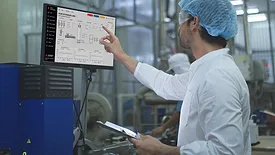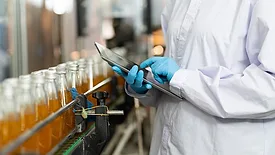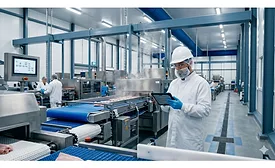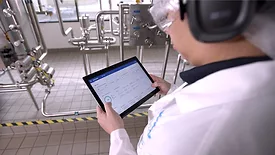
Food manufacturers have invested in predictive maintenance technology and analytics for the last ten years in search of more uptime. Now, food industry leaders are witnessing partnerships for data contextualization that could be the missing “ingredient” to successful AI projects.
The pursuit of improved operational margins is difficult, as CPG companies face over 20% in cost losses due to inefficiencies. Many are implementing advanced sensors and contextual data analysis to enhance maintenance and develop AI-driven strategies in manufacturing.
You have several data islands of automation, but by giving each data context — and with help from AI — you can keep the aging equipment and gain knowledge of your process.
Plants often have aging equipment that works fine, and it may have sensors, but in many cases that data never connects with data from other siloed processes. Why not connect all the data together with intelligent networks and use AI to get a better understanding of the whole process?
Food and dairy producers evaluate digital twin technology to improve quality and yield as operators begin to optimize real-time data analytics. As data modeling matures and adoption grows, operators are the essential players to support innovation and higher throughput.
AI may dominate industry conversations, but data modeling is delivering measurable results today. Discover how food, dairy and pet food manufacturers are using real-time production data to improve quality, increase throughput and give operators the insights needed to drive smarter decisions.
Food and beverage management is sold on data standardization in plants to support AI-based strategies. This early wave of data standardization projects and solutions is delivering increased context on traditional metrics, such as OEE.
In an evolving manufacturing landscape, leaders are leveraging AI and advanced analytics to enhance efficiency and decision-making. Contextual data and real-time insights are driving innovation, allowing companies like Ruiz Foods and Kraft Heinz to unlock significant value and optimize operations.
Two F&B manufacturers uncovered seven figures of recoverable loss by connecting dots with digital data.
Food and beverage plants often face hidden losses marked by discrepancies in yield, giveaway, and mass balance. While OEE measures capacity usage, it doesn’t provide insights into product quantity or waste, which can be revealed by analyzing quality data effectively.
Food and beverage plants are notoriously wasteful of water, and while the overarching call is to reduce water usage, cleaning/sanitation operations is a good place to start.
In an era where visibility and agility are becoming more essential, many food and beverage manufacturers are moving toward enterprise resource planning (ERP) solutions that help create a single system of record.
Data silos and poor data quality continue to impact AI adoption in CPG manufacturing, recent research from Veev shows, but continuing integration and unification is helping.
AI is revolutionizing manufacturing with applications in predictive analytics and product development. Despite challenges like data silos and integration, progress is being made towards agentic AI. Discover how companies are adapting and what the future may hold.
Over the years, seeking the perfect batch may have seemed like the quest for the Holy Grail, but today, let AI/ML-based batch serve as your experienced guide.
You don’t have to go it alone when searching for and maintaining the perfect batch. Through machine learning and AI-based batch control, the arduous search becomes easier to realize.