Automation
Don’t Scrap Your Equipment. Connect it Instead
You have several data islands of automation, but by giving each data context — and with help from AI — you can keep the aging equipment and gain knowledge of your process.
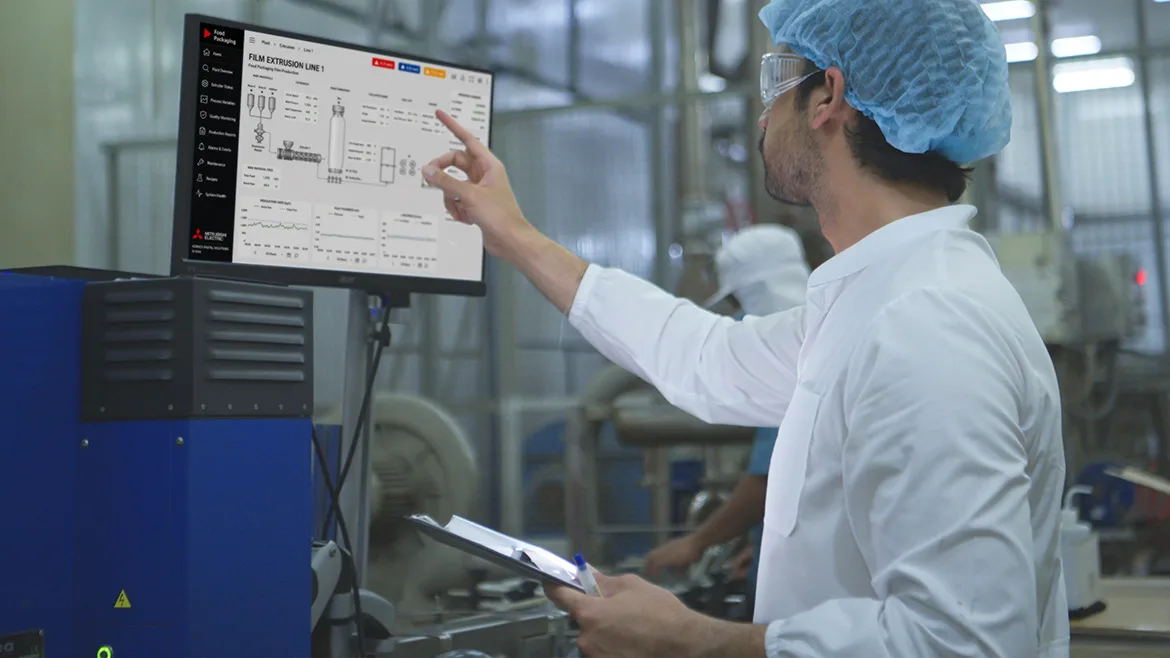
An operator checks in at the controls for a food packaging extrusion line. AI can help locate any issues related to process variables, quality monitoring, extruder status, alarms and more. Operators maintain control and AI can act and an advisor when things go wrong.
Many food and beverage facilities have gradually modernized over the years, resulting in islands of advanced automation alongside decades-old equipment. The challenge is less about replacing everything than connecting existing assets so that data from these islands can be analyzed in context.
With contextualized data, AI can assist operators by identifying trends, predicting problems and recommending actions. Data becomes far more valuable when it is associated with the product being made, the equipment involved, ingredients, operator, shift, recipe, work order, lot number and production conditions.
The "Nike Network," AKA "sneakernet," Still in Use
Depending on whom you ask, some plant networks still have disconnected "islands of data" with data from one island seemingly having nothing to do with another. But Sam Cafferata, principal engineer at Concept Systems, Inc., a CSIA (Control System Integrators Association) certified member, is optimistic. "The old ‘Nike Network’ and manual data collection are really relics of the past — or the world of a new low-budget startup adventure."
Virtually all production plants capture data automatically through the control system, Cafferata adds. Along with accuracy comes a whole host of other improvements and tools. Some of these include:
- Real-time alarming based upon bounds set by the process
- Automated responses to process conditions
- Analysis tools for comparing live process data to previously recorded operation, giving visibility to early comparison to "golden processes"
- AI is entering the process world as well, with the ability to use recorded and live process data to predict outcomes.
"Manual data is still happening at some facilities, but observational indications point to most facilities having migrated critical data points to automated data recording," says Chase Davis, director of technology at EOSYS, a CSIA certified member. "Another observation is that utilities or consumption-based data still seems to be recorded manually. Opportunities still exist for facilities to record usage statistics like natural gas, water, power and air. Automated data collection improves context and usefulness since it becomes easier to collect additional data points for evaluating connections between data points that might not be evident without collecting."
"Many food and beverage manufacturers currently take a hybrid approach to data collection," says Patrick Merlat, Dassault Systèmes CPG & retail industry process consultant. Process variables like Brix, temperature and pH, are often captured automatically while quality inspections, sanitation checks and operator observations continue to rely on manual input.
Data, however, becomes far more useful when it is automatically linked to the product, equipment, operator, batch and production order, transforming isolated measurements into actionable operational intelligence, Merlat adds.
Manual Recording Lives On
"Manual recording is far from gone, and I wouldn’t pretend otherwise," says Mark Reitzel, product management director for GENESIS, Mitsubishi Electric Iconics Digital Solutions. "Walk through most plants and you’ll still find Brix, pH and temperature checks written on clipboards or keyed into spreadsheets at the end of a shift. But if a variable matters to quality, safety, throughput or compliance, it shouldn’t live only on paper — and in food and beverage, compliance is often the strongest argument."
HACCP records, batch release documentation and traceability requirements like FSMA 204 all depend on records that are complete, time-aligned and tied to the specific product and lot, Reitzel adds. "Automated collection gives you that by default; clipboards give you an interpretation of it, hours later. And where electronic records replace paper, electronic signatures and audit trails — the requirements behind 21CFR Part 11 — are what make those records defensible when an auditor or a customer asks who recorded what and when."
However, Reitzel says some variables are easier to record than others. "There’s also an important middle step people skip past: not every check can be automated. Taste, aroma, texture and visual inspection checks are inherently human. The answer there isn’t a sensor — it’s digitizing the clipboard. Electronic operator rounds and mobile forms validate the value at the point of entry and automatically inherit the batch, equipment and shift context."
Because that context is the real improvement, Reitzel says. "A Brix reading by itself is just a number. The same reading tied to a product, recipe step, batch, line, CIP cycle and the surrounding alarms is evidence. That’s when you stop looking at numbers and start answering questions."
While Lance Fountaine, Rockwell Automation industry consultant for CPG, agrees there is still a lot of manual data entry related to process measurement, new inline systems are replacing these activities and provide real-time data access and automated control, though limits in measurements and higher costs inhibit adoption. Manufacturers are more often using tablets to facilitate data collection, eliminating extra steps in converting paper records to digital. "When data is collected, historized and contextualized, it becomes readily available to support improved process control and ongoing analysis. It can be used to visualize performance and drive ongoing continuous improvement," Fountaine adds.
Automated Data Collection
Automated collection improves accuracy and reduces the burden of entering the same information multiple times, says Andreas Eschbach, CEO and founder of Seq. "More importantly, digitized data can be easily searched and connected to other operational information. That provides critical context and allows teams to compare events across systems, shifts and production runs. Instead of an isolated reading, it becomes part of a usable operational history that supports faster investigation, stronger traceability and better decision-making."
"Automated collection improves more than accuracy," says Chris Lloyd, Syspro chief solutions & technology officer. "It connects process information to the product, equipment, recipe, work order, lot and production conditions involved. For example, a temperature reading becomes far more useful when it can be viewed alongside a specific batch, quality result or equipment event. For food and beverage processors, this context is especially important for maintaining lot genealogy, supporting HACCP monitoring and FSMA recordkeeping and managing recalls. By creating a more complete, traceable record of process conditions tied to each batch or lot, automated collection can also strengthen audit readiness and support regulatory compliance. That context helps teams identify patterns, investigate deviations and make better operational decisions."
Connect First, Replace Deliberately
Don’t throw the baby out with the bathwater — or as Reitzel advises: "Connect first, replace deliberately." If a machine still makes good product, the immediate goal usually isn’t replacement — it’s visibility. In practice that means some combination of add-on sensors (vibration, current, temperature), reading data directly from the existing PLC, protocol converters or OPC UA gateways for equipment that speaks an older language, and edge devices that can buffer data locally and forward it reliably.
"There are lots of retrofit technologies and many ways to get things to communicate into a central system," Cafferata says. "The key here is to evaluate the existing system and determine viability as well as maintainability. …Proper prior planning prevents… This really applies to the retrofit world. Take the time to make a plan." Many new sensors support various protocols for ease of installation and communication. Some of these are:
- Ethernet/IP
- IO-Link
- AS-I
Edge computers are also common, using a store-and-forward model to bring remote data reliably into a central system. Protocol converters are also a great way to extend the life of existing systems. Keep in mind these are not simple devices and will require knowledge of the existing system data in order to implement, Cafferata adds.
New inline measurement equipment is generally designed to transmit data, Fountaine says. They often use common protocols such as OPC UA or MQTT, but other new and legacy protocols can also be supported. Rockwell’s FactoryTalk Optix software is designed to ingest and export data using a variety of protocols.
"U.S. food manufacturers can modernize legacy equipment by adding smart sensors for vibration, temperature, pressure, energy and machine status, then using IIoT gateways and edge devices to connect that data to modern platforms," Eschbach says.
However, as we’ve said, the real value comes from adding business context to that data. With a platform like Seqonis, manufacturers can connect machine data with production, quality, maintenance and sanitation information, giving teams better visibility, faster problem resolution and stronger traceability without the cost and disruption of replacing existing assets.
It’s Not the Hardware, It’s the Siloed Software
Many plants have data confined to individual departments in separate software systems — siloed data — and even if it could be used outside of the department, there is often little or no context for the data other than a timestamp or a lot number.
"This is an area of great interest to us as system integrators and data junkies — so to speak — of the industrial world," says Concept Systems’ Cafferata. "Data can be mined from many areas and pulled into a central SQL database. This data is pulled with multiple tools such as protocol converters, edge gateways, remote I/O etc. This SQL database is the key; once the data is pulled from the various systems and combined in the SQL database, the world is your oyster. There are lots of tools to aggregate, associate and report on the data."
The critical point is that plant data needs names, relationships and meaning — not just timestamps, Reitzel says. A tag called TT-104 means something to the controls engineer, but nothing to the quality manager or the plant manager. When that same value is represented as the pasteurizer outlet temperature on Line 2 during a specific product run, it becomes useful to everyone. That’s what an asset model and a unified namespace provide: a common language that different systems and different people can share.
One approach to breaking down the silos is a movement called "Open Software Defined Automation (OSDA)," supported by Schneider Electric, Siemens and Bosch Rexroth with key ecosystem enablers being CODESYS, Honeywell and Rockwell Automation. OSDA decouples industrial control software from proprietary hardware, allowing automation systems to run on standard computing platforms and multi-vendor devices.
OSDA is helping manufacturers ensure their operations are future-proof, says Christine Bush, Schneider Electric director, Robotic Center of Excellence. "The O in open software-defined automation is critical. Rather than tying applications and control logic to proprietary hardware, manufacturers are empowered to modernize incrementally and manage automation software that reflects modern IT environments (open architectures, standardized interfaces and virtualization), while avoiding data that’s locked to one vendor."
By deploying OSDA, instead of a temperature reading existing only as a value with a timestamp, it can be tied to the specific asset, production line, product, batch, recipe, process step or quality event, Bush says. "With that context, the same information can be useful to operators, quality teams, maintenance personnel and production managers for monitoring performance, identifying issues and making decisions. This creates a more consistent, plant-wide view of operations while allowing facilities to integrate existing systems rather than replacing them to integrate alongside a particular vendors’ hardware."
Further decoupling hardware and software is the application of semantic data models, which will pair information around real manufacturing objects like batches or equipment with context into the relationships between them to create a common digital language across engineering, production, quality and supply chain functions, Merlat says.
AI Simplifies Complex Production Data
A goal of AI is to present complex production data in ways that operators, maintenance personnel, supervisors and quality staff can quickly understand and act upon.
"AI should make information easier to interpret, not add another layer of complexity," says Chris Lloyd, Syspro. Different teams need different views of the same operational data.
For example, an operator may need to see a production exception, while maintenance may need to understand a recurring equipment issue. Quality staff may need to trace a deviation back to a batch, ingredient or production condition.
AI can surface the information most relevant to each role, explain why it matters and highlight the next action. People should also be able to see what data informed the recommendation AI is offering and be notified when human review is needed, Lloyd says.
The challenge facing many manufacturers today is not a lack of data, but the difficulty of processing the growing volume of information available to them, says Kate Brown, partner, Wipfli LLC, a CSIA member. AI can help by transforming thousands of data points into simple, actionable recommendations tailored to specific users. Rather than asking an operator to interpret dozens of trends and charts, AI can identify an emerging issue and explain the likely cause in plain language. For example, if production conditions indicate a potential yield loss, AI can notify the operator and recommend a process adjustment before product quality is affected. Maintenance teams may receive alerts about equipment conditions most likely to result in downtime, while quality personnel may be notified of batches trending toward specification limits. The most effective AI solutions do not overwhelm users with more data; they help them focus on the actions that matter most.
"Manufacturers can leverage agentic AI solutions built on contextualized data with semantic understanding of various stakeholder roles to ensure the right person is getting the right data at the right time," Merlat says. "AI can answer questions in a natural language, explain recommendations and guide users to the next best action based on their role."
"I frame AI as a plant-floor assistant, not a replacement decision-maker," Reitzel says. "An operator shouldn’t have to inspect 40 trends, 20 alarms and three reports to understand a problem. AI should be able to say: ‘This batch is trending differently than the last five similar batches. The temperature deviation started after the valve position changed. Here are the related alarms, the affected equipment and the likely next checks.’ That presentation is valuable because it shortens the path from data to action."
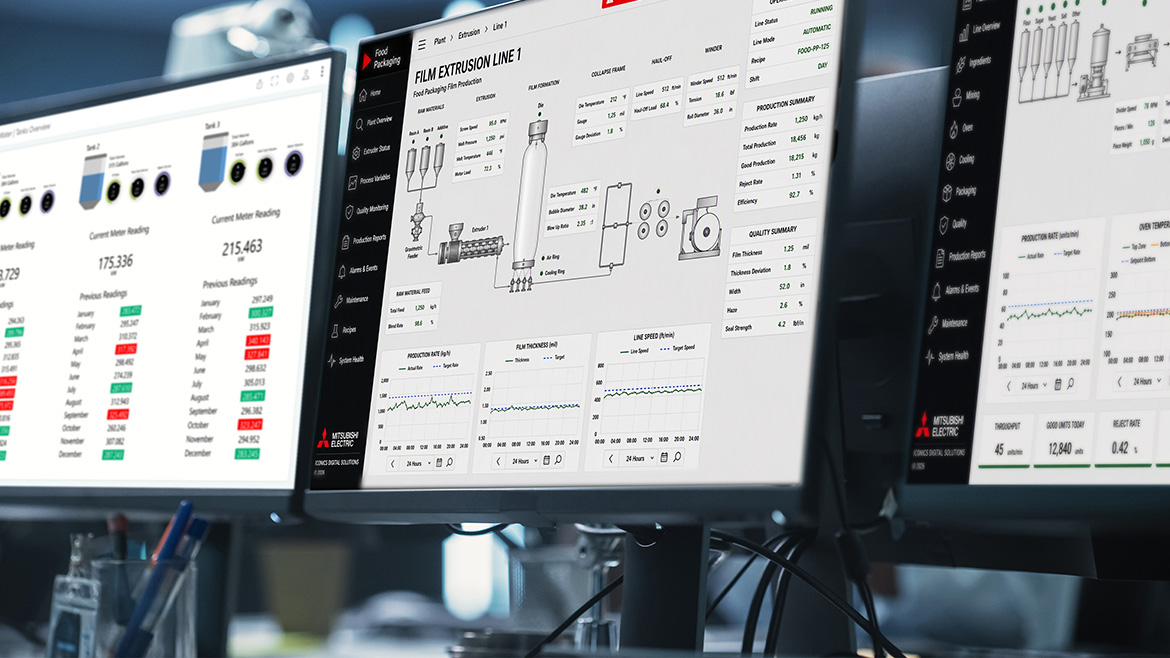
An operator console for a food packaging film extrusion line, which provides graphs of production rate, film thickness and line speed. Based on current statistics, AI can alert operators of potential issues before serious maintenance problems occur. Photo courtesy of Mitsubishi Electric Iconics Digital Solutions
AI Helps Identify Root Causes
"The adoption of AI into practice is really a maturity journey," says Rockwell Automation’s Fountaine. "In its earliest stages, you are working to turn complex, incomplete and disjointed data into an information asset that can serve your current and evolving reporting, analysis and project needs. Once you have this dataset, in the next stage of maturity, you can start to use it for queries (copilot), situational awareness, problem investigation, root cause analysis (RCA) and predictive machine learning."
AI is strongest when it accelerates investigation, Reitzel says. Root cause analysis is hard in a plant because the cause is rarely in the same system as the symptom — a quality deviation might trace back to a valve response, a cleaning cycle, a raw material lot, a maintenance change or an operator intervention. AI may not always "know" the root cause outright, but it can narrow the field fast — compare this batch to previous good batches; identify what changed; correlate the time-series data with alarm history, operator actions and maintenance events; and point the engineer at the most relevant signals.
The next generation of AI goes further, says Seq’s Eschbach. Agentic AI can continuously monitor operations, proactively detect emerging patterns, recommend corrective actions based on prior outcomes and alert the right teams before issues escalate. By harnessing the organization’s collective intelligence, it brings together operational data, institutional knowledge and frontline expertise from across shifts, plants, and business units.
"With humans firmly in the loop, AI serves as a decision-support system, not a decision-maker," Eschbach adds. "People remain accountable for validating root causes, approving corrective actions and driving continuous improvement. The result is a continuously learning organization where knowledge is captured, shared and applied at scale."
To the Future: Data Analytics, Contextualized Data and AI
A strong data strategy and related data capabilities are a key enabler to next generation continuous improvement and innovation, Fountaine says. The availability of ready and waiting data "lowers the cost of curiosity" and allows your greatest asset (your people) to rapidly investigate, ideate and validate quality and performance opportunities. When the "cost of curiosity" is too high (meaning, it is an extensive and time-consuming exercise to go and collect all the information you need to investigate and analyze), ideas lose interest and momentum and are likely to slowly fade away. Part of the idea of Smart Manufacturing/Industry 4.0 is to arm your organization for the future, and data is one of the most critical steps in that journey.
Looking for a reprint of this article?
From high-res PDFs to custom plaques, order your copy today!