4 Ways to Reduce Product Loss in Fluid Ingredient Processing
Ask most food manufacturers where ingredient loss occurs, and the answer is usually, "a little bit everywhere."
Product can be left behind in containers, lost during transfers, damaged in handling or discarded due to inventory expiration or poor stock rotation. Over time, these incremental losses add up, especially when working with viscous or high-value liquid ingredients, where even small amounts of residual material can have a measurable impact.
So, what can manufacturers do to improve product yield?
While there are many ways to reduce unnecessary waste, one practical approach is to improve packaging and handling processes.
To do this effectively, it’s often helpful to follow the ingredient’s journey step by step, evaluating four key questions along the way.
1. Where is product being lost, wasted or discarded during processing?
Common sources of loss include transfer-related spills, packaging damage, residual ingredients left behind after discharge and ingredient spoilage.
To identify the biggest drivers and quantify their impact, manufacturers should first map the end-to-end process. From there, the focus can shift to areas of greatest opportunity. This approach aligns with industry best practices. Research from McKinsey found that manufacturers who first focus on flow and waste reduction often see productivity and cost savings follow.
While some drivers of waste require specialized, engineered solutions, others can be addressed through everyday operating practices. Often, some of the most feasible opportunities are found in packaging and handling processes, such as container design, liners, valves and discharge methods.
These packaging-related factors are especially important during ingredient transfer, which is a common source of avoidable waste worth looking at more closely.
2. What causes ingredient loss during transfer?
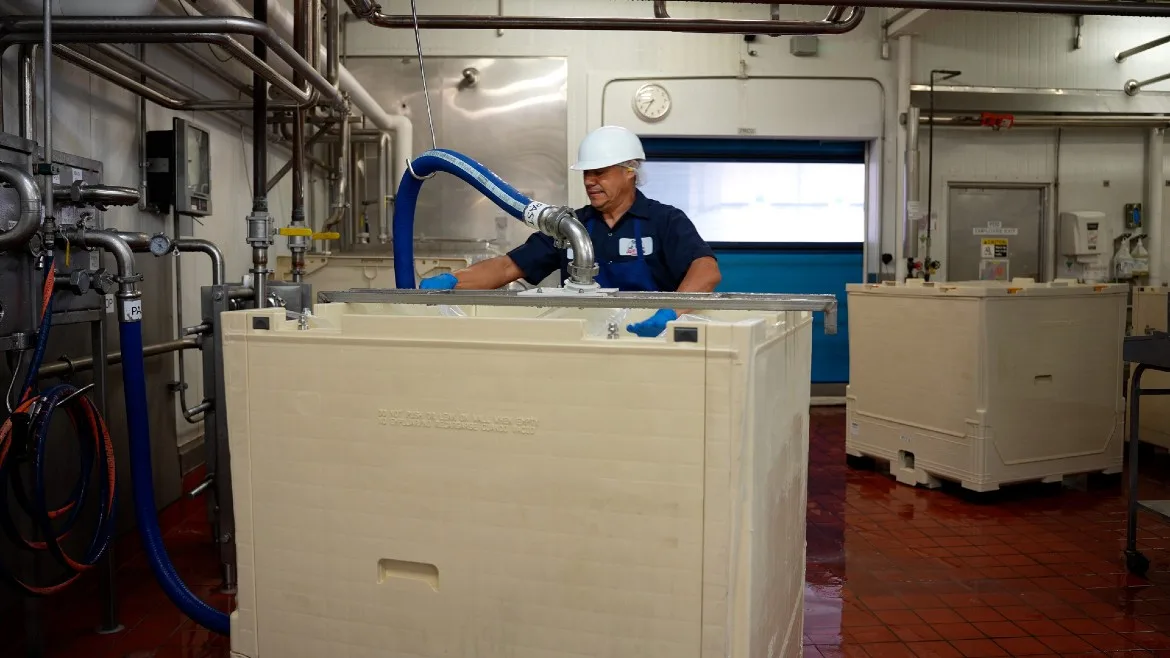
Variability during product transfer can increase the risk of loss, and packaging is often a bigger contributor than teams realize. Many facilities use a mix of drums, cardboard totes and intermediate bulk containers (IBCs), which introduces additional complexity to daily operations.
Each container type comes with its own handling requirements, procedures and equipment considerations. That means operators are constantly switching between different protocols, increasing the likelihood of spills, handling errors and other inefficiencies.
Since the filling and discharge process is multifaceted, there’s no one fix. Material moves through a series of valves, piping, pumps and hoses as it travels between a tank, process line or bulk container. Every connection point creates the potential for shrinkage, whether from poor hose routing, inconsistent procedures, air ingress or differences in how the task is performed.
One of the simplest ways to minimize variability is to standardize packaging. This helps create more repeatable processes for operators while also making it easier to track recovery rates, performance gaps and improvement opportunities.
In many cases, larger-format IBCs further simplify operations by consolidating volume, requiring fewer touchpoints than buckets, drums or cardboard totes.
Other areas to evaluate include pump and piping system design, which may require a more specialized approach with engineering considerations.
Of course, even when transfers are performed consistently, product can still be left behind after discharge of totes or tanks, presenting another opportunity for recovery.
3. How can residual waste be reduced during discharge?
Anyone who has watched a tote empty knows that not every material flows easily. Thick, viscous ingredients often cling to tote walls, collect in low points, or remain trapped in folds and corners.
By weighing containers after discharge to determine how much usable product remains, manufacturers can establish a baseline of residual loss to measure and improve against. Then, upgraded packaging systems can be explored, such as bottom-discharge container designs, compatible valves and adapters, and assisted-evacuation technologies.
South Mountain Creamery provides an example of how packaging decisions can increase product recovery. In 2025, the company switched from corrugated totes to reusable liquid IBCs with a recessed decant design, reducing residual cream waste by an average of 15-30 pounds per tote and generating meaningful cost savings on every shipment.
However, transfer and discharge are only part of the picture. What happens before and after processing is just as important to protecting yield.
4. Are handling practices creating hidden waste?
Storage, transportation, staging and other routine tasks can create preventable waste before product ever reaches the production line.
Container damage is one common example. Forklift punctures, unstable stacking and rough transportation conditions can lead to spills, contamination or the loss of an entire container's contents. Tracking how often packaging is damaged before reaching the process line can help uncover overlooked causes of loss.
Inventory practices matter, too. Poor stock rotation and limited inventory visibility can result in ingredients sitting idle or being misplaced, increasing the risk of spoilage.
Some manufacturers address these challenges through pooled reusable container programs. Because the assets are designed for repeated use, they're built to withstand the rigors of handling and transportation. At the same time, pooling networks often provide greater visibility into platform and inventory flows, especially when combined with digital or serialized solutions that enable more precise tracking capabilities.
What’s key to remember is that no single change eliminates product loss. The greatest progress results from combining the right packaging choices with smarter operating practices.
Looking for a reprint of this article?
From high-res PDFs to custom plaques, order your copy today!