Mixing & Blending
Mixing and Blending of Dry Ingredients: Art Gets a Little Help from Science
The mixing and blending of liquids into a liquid product is a controlled science, but combining dry ingredients has been more art than science.
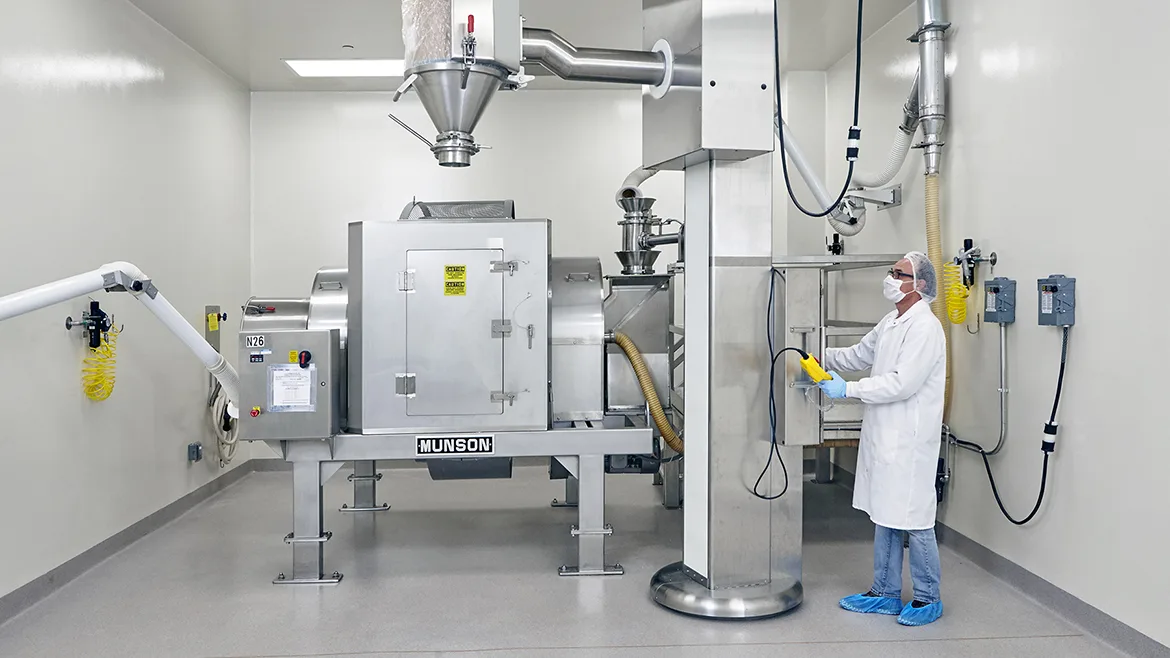
A 40-cu.-ft. capacity Munson Model 700-TS-40-SS rotary batch mixer handles dry ingredients at a nutraceutical supplements manufacturer.
The mixing, blending and production of liquids and slurries — such as beverages, concentrates, sauces and syrups — already benefit from sensors and controls, as this level of production typically involves online and inline sensing systems. Nevertheless, the production of dry products like cereals and mixed spices or teas typically requires machines such as ribbon blenders or paddle mixers and has been largely an "art" practiced by individuals with core/tribal knowledge of how to make a "perfect batch" of a certain product. Sensors and control have been much more difficult to apply in blending dry components.
Handling the mixing and blending of dry ingredients is getting some help. Machine suppliers are using automated design (CAD) technologies to build more efficient and easier-to-clean machines with better product handling capabilities, while new sensor technologies and AI/ML offer advice on the mixing/blending process of dry ingredients into a product.
Equipment and Technology
For food processors looking for mixing and blending equipment, there is no shortage of types available. Munson Machinery alone offers eight categories of mixing/blending equipment in a range of sizes, covering virtually any batch or continuous dry-end mixing and blending application — from laboratory testing to high-volume production. These include ribbon/paddle/plow blenders, rotary batch mixers, rotary batch mini mixers, cylindrical plow blenders, fluidized bed mixers, continuous rotary blenders, continuous variable intensity blenders and vee-cone blenders.
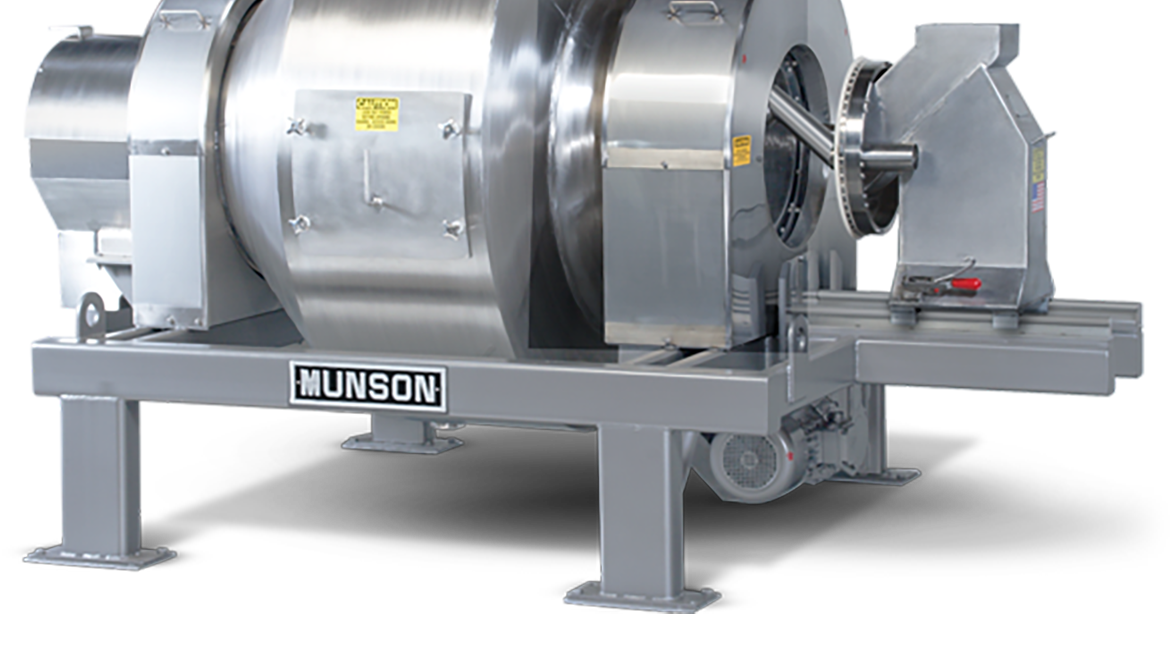
Rotary Batch Mixers eliminate internal shafts and seals, removing crevices where particles could otherwise collect. Quick-opening access doors and retractable inlet chutes provide unobstructed access to all product-contact surfaces for fast, thorough cleaning, sanitizing and inspection. Image courtesy of Munson Machinery
Although these machines can handle liquid-containing formulations, they are classified as "dry-end" equipment in the chemical process industries, which includes food and cosmetics, as distinguished from "wet-end" mixers for liquid ingredients, says Steve Knauth, marketing and technical manager, Munson Machinery Co., Inc.
"Tetra Pak helps food processors think beyond a single mixer or blender — and designs the entire production line around quality, food safety and hygiene, efficiency and repeatability," says Hayfa Boussoffara, powder technology specialist, Food Process Engineering, Tetra Pak US and Canada/Processing Solutions & Equipment. "For solid materials, the biggest challenge is often ingredient variability, including differences in particle size and shape, flowability and fragility."
"Our role is to help translate those product and business needs into the right mixing technology, feeding and dosing approach, level of automation and data collection strategy," says Jean-Christophe Margotteau, business developer powder process and technology, Tetra Pak US and Canada Processing Solutions & Equipment. "We also help customers move beyond relying solely on operator knowledge toward a more data-driven, and therefore, more reliable process, using parameters such as ingredient quantities, feed rates, torque, batch time and homogeneity measurements."
Siemens supports food processors as an automation, digitalization and software partner, says Adam Harris, Siemens Industry technical sales manager, Life Sciences & CPG. "We help processors connect ingredient handling systems, mixers, conveyors, quality systems and packaging equipment into a unified production platform. Our focus is on recipe management, process control, operational visibility, traceability, and using production data to improve consistency, throughput and flexibility."
Food Processor Demands
"While Siemens does not build the equipment, the biggest demands we see are increased product variety, shorter production runs, greater traceability and improved operational efficiency," Harris says. Processors want systems that can execute recipes more consistently, support rapid product introductions and provide production insights that help reduce waste, downtime and energy consumption.
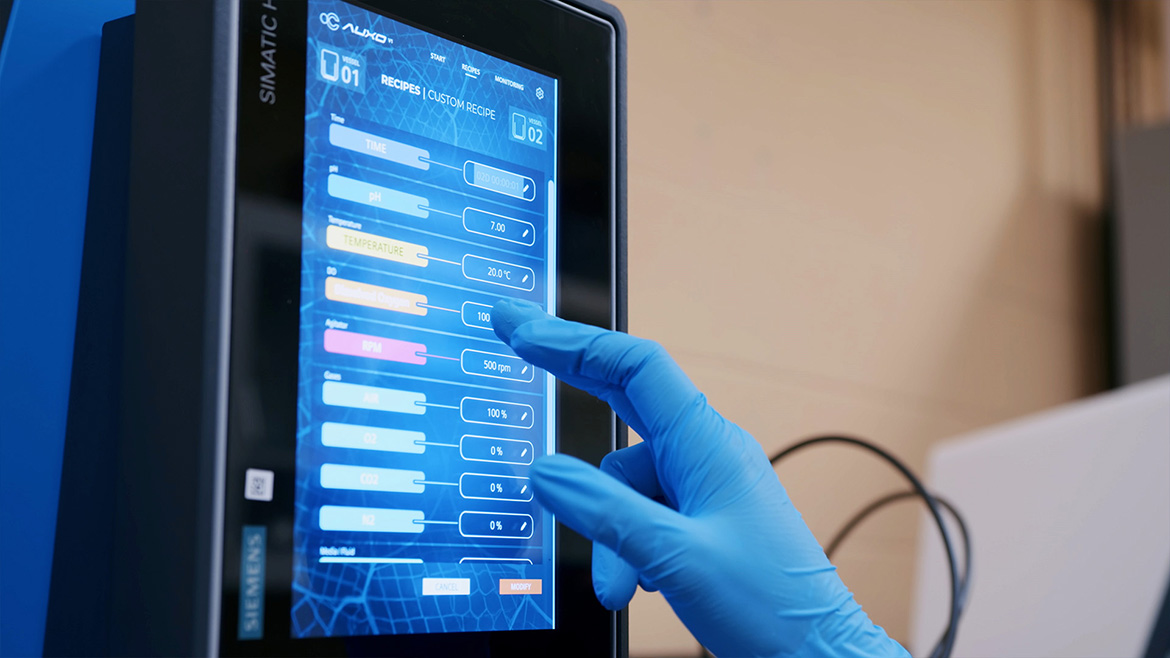
Digitalization and flexible automation controls empower processors to switch between recipes more efficiently while maintaining food safety standards. Image courtesy of Siemens Industry
Knauth sees the demand for rapid sanitization, automated ingredient dosing and flexible recipe changes, while also configuring machines to conserve energy and water in support of sustainability goals.
Energy use varies by mixer type due to differences in motor size and cycle time between agitated and tumble designs. For example, a Munson ribbon blender, with average cycle times of 5–6 minutes, uses roughly 75% more energy per unit of material processed than a rotary batch mixer of identical capacity and one to three-minute cycle times.
That said, mixer selection typically hinges less on energy efficiency than on the mixing action a given design provides, Knauth says. Reliability is critical, since mixing/blending typically occurs mid-process, and an interruption can affect both upstream and downstream operations. Some Munson mixers/blenders have operated continuously for more than 65 years.
Food and beverage processors are looking for greater flexibility, scalability and process confidence as they manage growing product portfolios with shorter production runs, faster changeovers and fewer opportunities for quality holds, Margotteau says. For example, processors are looking for scalable solutions that allow them to increase throughput over time. With new-generation mixers capable of achieving mixing times of around 90 seconds, the number of batches produced per hour can be increased significantly while keeping the same mixer in place.
At the same time, there is a strong focus on leaner manufacturing. Processors increasingly want to eliminate intermediate premixing steps and feed micro-ingredients directly into the main mixer while still achieving accurate dosing, rapid dispersion and consistent blend homogeneity. This helps simplify production, reduce handling and improve overall efficiency.
Another major demand is enhanced visibility and traceability throughout the production process. Manufacturers are investing in scalable automation platforms that can integrate recipe management, ingredient lot tracking, batch records, sanitation verification and quality data into a single system.
As regulatory requirements continue to evolve and contamination prevention and allergen control receive greater scrutiny, processors also need robust production records that demonstrate compliance. They require immediate access to information on recipe execution, ingredients and lot traceability, batch history, and cleaning and sanitation verification. This level of traceability not only supports food safety and regulatory compliance but also provides greater confidence in product quality and operational performance, Margotteau says.
Improvements in Equipment
Equipment designs have become much more modular and hygienic, Harris says. Processors are looking for faster changeovers, reduced allergen risk and the ability to handle a wider range of products with the same equipment. Improved sanitary designs, better cleanability, integrated diagnostics and flexible automation controls allow processors to switch between recipes more efficiently while maintaining food safety standards.
"Recent generations of powder mixers have also been designed with cleanability as a key priority," Margotteau says. "For example, the Tetra Pak Powder Mixer B features a design in which the motor and paddle shaft assembly can slide away from the mixing vessel, providing full access to the interior for inspection and manual cleaning. This open and accessible design allows all product-contact surfaces to be reached easily and safely."
The mixer is fully openable and has been engineered to minimize cleaning downtime, Margotteau adds. A thorough manual dry cleaning can be completed by a single operator in approximately 90 minutes, which represents a significant improvement in both operator safety and operational efficiency. For powder processors, this level of accessibility and cleanability is a genuine game changer.
"Today, the most advanced mixing technologies are based on the principle of convection mixing, such as twin-shaft paddle mixers," Boussoffara says. "Their two synchronized shafts provide faster, more efficient and gentler mixing, enabling high blend homogeneity while preserving sensitive ingredients."
Versatility comes from the short mixing times these technologies achieve. Processors can produce smaller and more frequent batches, making it easier to handle a wider range of recipes, respond to changing demand and reduce inventory requirements.
"Another important advancement is the ability to incorporate liquid ingredients directly into the mixer through dedicated spraying systems," Boussofara says. "By finely atomizing liquids and controlling when they are added during the mixing cycle, processors can achieve more uniform distribution, better process control and more consistent product quality."
Are Lines Easier to Set Up Today than 10 or 20 Years Ago?
"Yes," Knauth says. "Regardless of the mixer/blender specified, today’s equipment is commonly fitted with one or more PLCs and an array of sensors, enabling greater energy savings and process efficiencies than were previously achievable."
Another "yes" from Harris. "Siemens directly supports system integrators with standardized communication protocols, modern PLC platforms, digital engineering tools and simulation technologies to make projects more predictable than in the past. Digital twins and virtual commissioning allow teams to validate control strategies before equipment is installed, reducing startup time and helping identify issues earlier in the design process.
Boussoffara gives a thumbs-up. "Today, system integrators can rely on much more advanced characterization, testing and process validation tools than were available 10 or 20 years ago. State-of-the-art laboratory tools — such as particle size analysis, flowability testing, shear testing, bulk density measurements and moisture characterization — provide a comprehensive understanding of powder properties, enabling the prediction of ingredient behavior during process. This provides a much deeper understanding of the product before any industrial equipment is specified.
"The next step is pilot testing, where process parameters can be optimized under realistic operating conditions," Boussoffara adds. "Pilot trials help determine the optimal mixing time, ingredient incorporation sequence, liquid addition strategy, recipe design and cleaning procedures. They also allow manufacturers to validate product quality targets and evaluate how automated processes will perform in production."
As a result, industrial lines can be designed and commissioned with a much higher level of confidence, Boussoffara says. The combination of ingredient characterization, pilot-scale validation, advanced automation and data collection reduces commissioning time, minimizes risk and helps ensure that the line achieves the expected performance from day one. Ultimately, this means fewer surprises during startup, faster time to production and more predictable operational results.
Automation Helps Everyone Involved
From supplier to integrator to food processor, automation provides a boost to everyone. "The biggest advances lie in the technology used to design and manufacture equipment, and to control and monitor it once installed," Knauth says. Continuous improvements in 3D CAD software and programmable controls give engineers greater customization and efficiency at lower cost, while semi-automated cutting and welding centers have streamlined production and tightened tolerances. Precision sensors for rotation, speed, heat, level and vibration relay data to programmable controls that monitor, integrate and automate mixers, blenders, conveyors, feeders, heaters/coolers and entire process lines with unprecedented efficiency.
For processors, Harris says automation makes it easier to manage a growing number of SKUs while maintaining consistent execution. Recipe management systems ensure the correct ingredients, quantities and process parameters are used every time. Vision systems, AI-enabled inspection tools, specialty sensors and real-time analytics can identify quality deviations much earlier than traditional manual inspections. This improves consistency, traceability and food safety while reducing waste and rework.
Automation helps processors create more product types while reducing variability in how those products are made at scale, Margotteau says. Recipe-controlled systems can standardize ingredient additions, target-weights, sequencing, mixer speed, batch time, discharge timing and quality checks. Sensors and software also support a shift from end-point inspection to in-process understanding by flagging issues earlier, such as under-dosing, feed interruptions, environmental changes or abnormal torque and power patterns. Vision, color, near-infrared (NIR), vibration or acoustic sensors may also be useful in selected applications, depending on the quality attribute that matters most.
In powder mixing, speed monitoring is particularly important because it ensures operation within the target Froude number (ratio between convection forces and gravitational forces acting on the powder), Boussoffara says. Maintaining the correct operating conditions is essential to achieve the desired blend homogeneity and product consistency.
Specialized sensors are also playing an increasingly important role, Boussoffara adds. "For example, cameras installed inside the mixer can automatically detect fouling or product buildup and trigger alarms when cleaning or inspection is required. In addition, NIR technology provides real-time monitoring of blend uniformity, enabling accurate mix end-point determination and consistent product quality while reducing sampling, laboratory testing and batch variability."
Automation is also improving food safety and sanitation, Margotteau says. "For example, the Tetra Pak Air Jet Cleaning system for Powder uses a combination of controlled air jets and vacuum extraction to remove automatically powder residues from the mixer and other powder-handling equipment. The system can significantly reduce cleaning time, improve cleaning consistency and minimize operator intervention while supporting contamination prevention and allergen management programs. By automating part of the cleaning process, processors can increase equipment availability, improve repeatability and strengthen overall food safety performance."
AI Supports Mixing/Blending Decisions
"AI can help operators understand relationships between ingredient characteristics, processing conditions and final product quality," says Chris Polster, principal application engineer, Siemens Industry. "It can identify patterns, predict quality outcomes, recommend process adjustments, detect anomalies and support predictive maintenance. When paired with physics-based digital twins, AI can also simulate process behavior and optimize control strategies before quality issues occur. Over time, AI can help capture experienced operator knowledge and make it available across the organization."
"AI can support non-liquid mixing and blending, but only when the right data foundation is in place," Boussoffara says. "Processors first need clean, connected and contextualized data on ingredients, sequencing, timing, environmental conditions, cleaning records, batch results and quality outcomes. With that foundation, AI can help identify patterns across many batches, predict quality deviations earlier and recommend adjustments to blend time, speed or sequencing based on raw material variability. AI should be viewed as decision support that works alongside food scientists, process engineers and operators, not as a replacement for their expertise."
Looking for a reprint of this article?
From high-res PDFs to custom plaques, order your copy today!